A growing market can still be a hard business
A busy neighborhood has an empty shopfront. Chapter House can picture the shelves, the launch event, and the extra readers. Its harder question is what will remain from each sale after stock, service, and premises are paid for. More passing customers are useful only if the new shop can keep enough value to survive.
Chapter House is a hypothetical independent print-book retailer considering a second shop in its city. All conditions, customer concerns, and possible decisions described here are fictional.
Porter’s Five Forces examines five sources of competitive pressure in an industry: rivalry, new entrants, suppliers, buyers, and substitutes. The framework helps explain how industry structure affects the ability to keep attractive returns.
Michael Porter introduced the framework in 1979 and revisited it in 2008. Use it when considering a market, reviewing a difficult competitive position, or testing whether growth will really translate into profit.
Define the business before naming the pressures
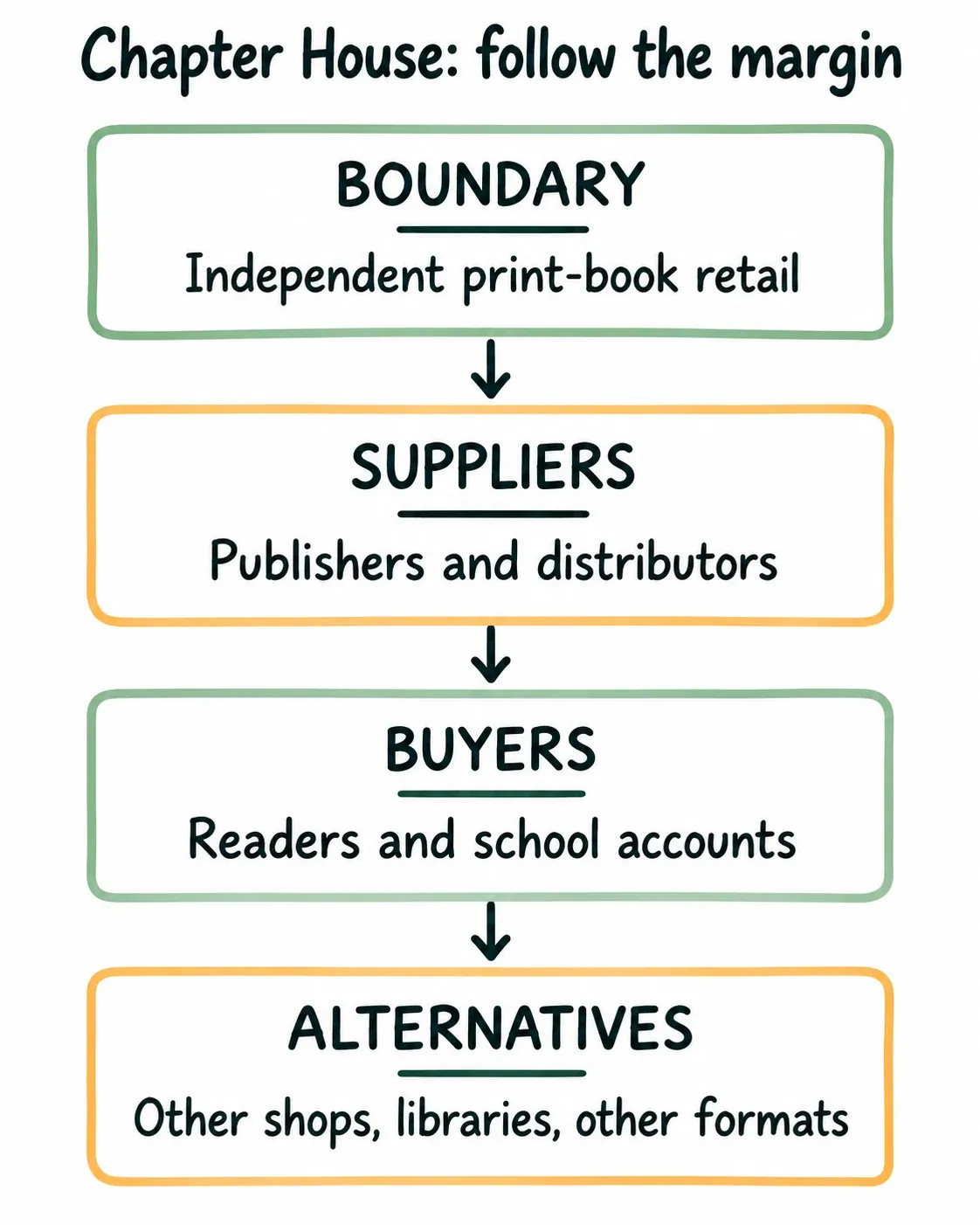
Chapter House chooses independent print-book retail in its city as the working boundary. That makes other bookshops rivals, publishers and distributors suppliers, and libraries or other reading formats possible substitutes. Change the boundary and some classifications change too.
The first map follows the transaction rather than ranking threats. Who supplies what the shop must sell? Who buys, with what alternatives? Where could price or cost pressure enter? Those questions give the five forces something concrete to explain.
Ask five different questions
Rivalry is only one pressure. Suppliers, buyers, entrants, and substitutes can also affect the value available to Chapter House, even when direct competitors behave politely.
Rivalry: how do existing competitors fight?
Rivalry concerns businesses already competing in the defined industry. Ask whether they fight mainly through price, selection, service, convenience, or something else.
For Chapter House, several bookshops may compete for the same readers. If their stock and buying experience look interchangeable, discounts become an obvious way to win a sale. If customers value a distinctive selection or a trusted bookseller, the comparison may be less purely about price.
High fixed costs, slow demand, similar offers, and difficulty leaving a market can intensify rivalry. Simply counting competitors is not enough. Three determined rivals may create more pressure than twenty businesses serving different needs.
Identify how the contest changes prices or costs. “Competition is fierce” names a mood. “Rivals discount the same popular titles, reducing the margin on our largest sales category” explains an economic effect.
New entrants: what keeps another business from joining?
The threat of entry exists before a new competitor actually opens. If entry looks easy, current businesses may keep prices down or spend more to retain customers.
Barriers can include capital, reputation, access to distribution, economies of scale, regulation, and customer switching costs. Their importance depends on the industry and the business model.
Chapter House asks how difficult it would be for another retailer to obtain stock, find premises, and attract local readers. Opening a small shop might be possible, while building trusted school relationships or a reliable events audience could take longer.
Do not confuse an entry barrier with an internal inconvenience. “We found hiring tiring” is not automatically a barrier that protects everyone already in the market. Ask whether a capable newcomer would face a durable disadvantage.
Suppliers: who can raise your costs or set terms?
Supplier power rises when a necessary input has few credible sources, is difficult to replace, or is costly to switch away from. Suppliers may also have leverage if they can move into the customer’s part of the value chain.
For Chapter House, publishers and distributors influence available titles and purchasing terms. A small retailer may struggle to negotiate favorable conditions. Its own loyal customers do not necessarily change the supplier’s negotiating position.
Name the supplier group and the dependency. In another business, a scarce technical skill or a specialist component might matter more than a traditional materials vendor.
Ask what happens if the supplier changes price, delivery timing, or access. If you cannot substitute an input without changing the offer customers want, supplier power deserves close attention.
Buyers: who can push your price down?
Buyer power concerns customers’ ability to influence price or terms. It can rise when buyers are concentrated, purchase large volumes, can switch easily, or can do the work themselves.
Chapter House’s individual readers are small buyers, but they can compare the price of a familiar title elsewhere. A school placing a large recurring order may have a different kind of leverage because losing that account matters more to the shop.
Keep those groups separate. “Customers matter” is true but does not tell you which customers can extract better terms or why.
A buyer may have less leverage where switching is disruptive, the offer is differentiated, or a poor choice creates serious consequences. Check the actual circumstances instead of assuming that every loyal customer is unable to switch.
Substitutes: what else gets the result?
A substitute meets a similar need in a different way. It may come from outside the industry you usually monitor.
For print-book retail, libraries and other reading formats can substitute for some purchases. The exact boundary depends on your defined market. If you include every reading format inside the industry, you must adjust which alternatives count as substitutes rather than rivals.
This is why market definition matters. A bookshop comparison that treats every alternative as another bookshop will miss the reason some readers do not buy at all.
Assess the substitute’s price and performance for the relevant need. A cheaper option that customers consider good enough can put a ceiling on what they will pay, even if they like the original offer.
Apply all five to one decision
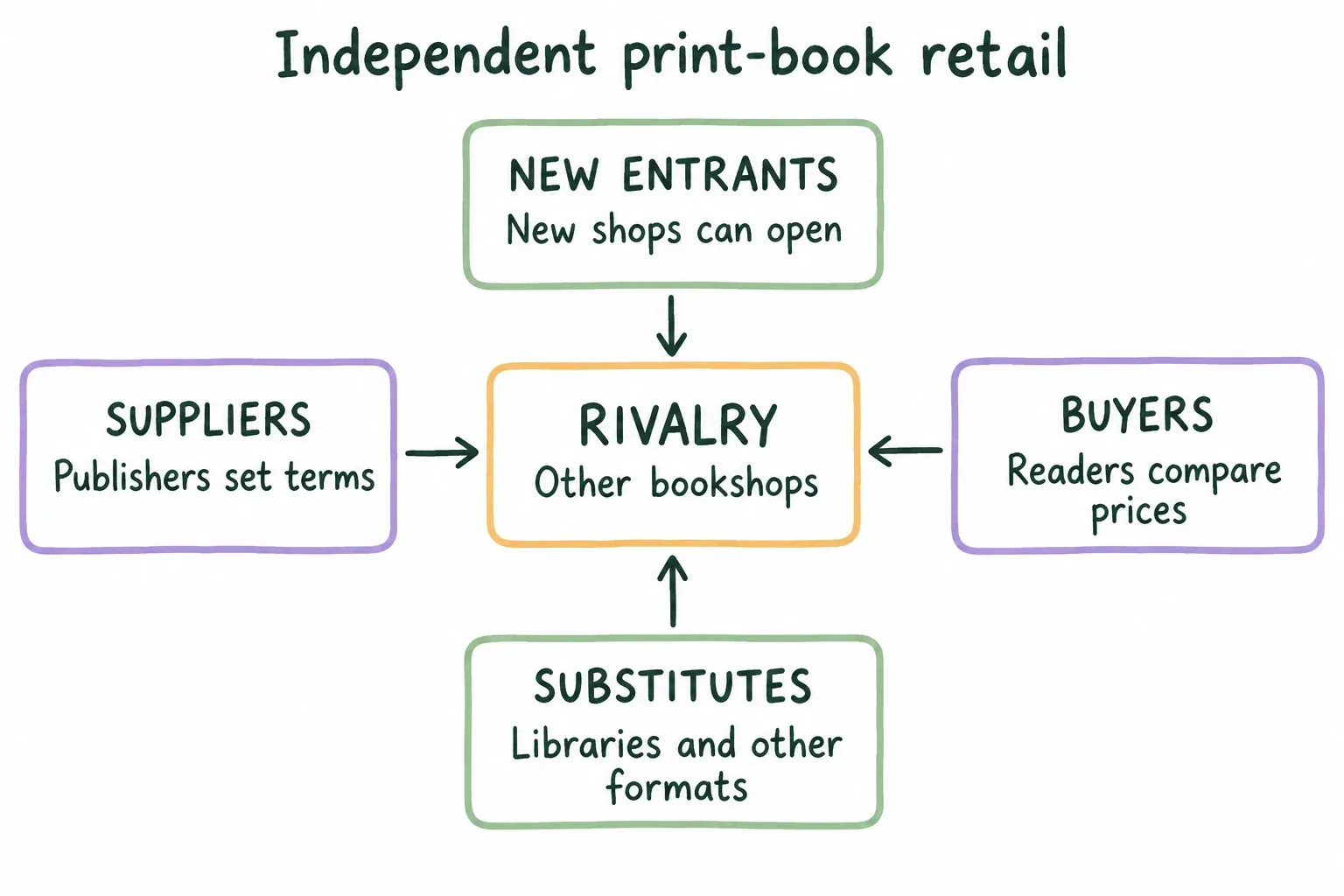
Chapter House initially assumes a busier neighborhood will make a second shop attractive. The forces suggest a more demanding question: can the new shop keep enough value after purchasing terms, price comparison, alternatives, and local rivalry are considered?
The team sees that copying its general selection into another location would expose it to familiar price comparisons without improving supplier terms. It considers an alternative: a smaller site focused on a defined reading community, with events and school-order services that customers actually value.
That position is a hypothesis. Events may cost more than they earn. Schools may already have better purchasing arrangements. The team needs customer and cost evidence before committing to a lease.
The framework has improved the decision by exposing the assumptions a “growing neighborhood” story left out. It has not demonstrated that a niche is always profitable or that differentiation eliminates competitive pressure.
Test a position before signing the lease
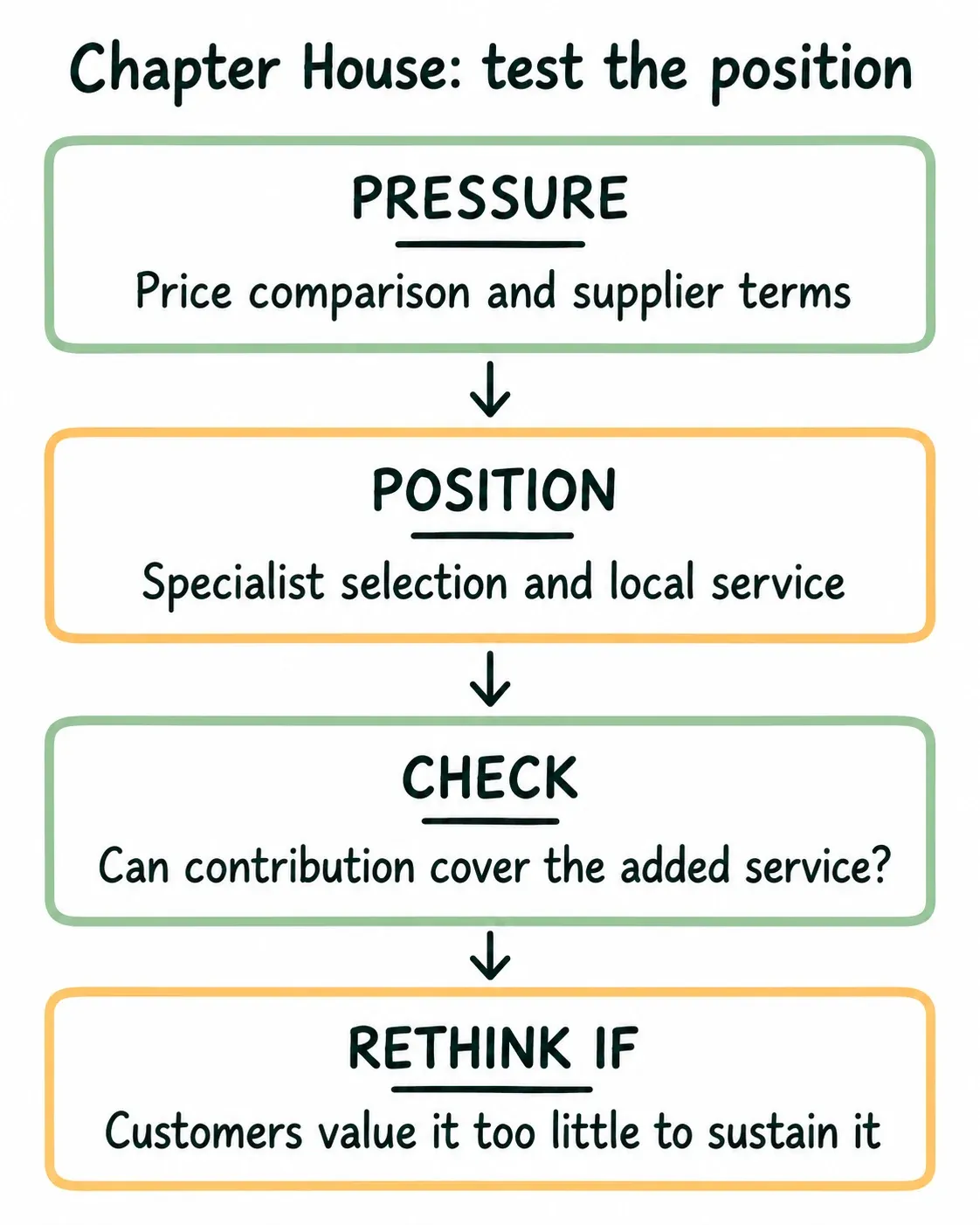
The emerging proposal is a smaller specialist site with local service and school-order support. Those activities could make the shop more useful to a particular audience. They also consume time and money; “different” is not a synonym for profitable.
Chapter House can investigate actual purchasing terms, the contribution from a realistic order mix, and whether readers or schools value the proposed service. If the added service cannot support its cost, it must revise the position or the expansion. The diagram cannot sign a sustainable lease on the team’s behalf.
Run an analysis that leads somewhere
FrameworkWorld recommends these working steps:
- Define the industry, geography, and period. Use boundaries that make the actors and substitutes intelligible. Record disputed boundaries explicitly.
- Name actors for every force. Identify supplier groups, buyer groups, credible entrants, existing rivals, and different ways customers meet the need.
- Describe leverage and its mechanism. Look for concentration, switching costs, access, price comparisons, and credible alternatives. Attach evidence and dates.
- Separate structure from a temporary event. A bad month is not a force. A lasting reduction in switching costs may change one.
- Inspect interactions. Price-sensitive buyers and undifferentiated rivals can reinforce each other. A supplier cost increase can be harder to absorb when rivalry prevents price increases.
- Write the implication for your options. Explain which position might reduce exposure, what it would require, and which assumption needs testing first.
A useful final statement is more specific than “buyer power is high.” For Chapter House: “Popular titles invite easy price comparison, so the second site needs a customer-valued reason to choose us that covers its additional operating cost.”
Don’t let the diagram overpromise
The framework examines industry structure. A particular company can perform better or worse because of its position and execution. Attractive industry conditions do not guarantee a well-run business, and difficult conditions do not make every company identical.
Growth alone is not a sixth force. Technology, government, and broad trends matter through the way they change entry, bargaining power, rivalry, or substitutes. Trace that relationship rather than adding a new box for each headline.
Avoid counting the same relationship several times without explaining it. A distributor that also sells directly may be a supplier and a competitor; those are distinct roles worth analyzing, not a reason to merge the questions.
The model is also a snapshot. New channels, business models, and customer habits can change the relevant industry boundaries. Date the analysis and revisit the assumptions when those changes become material.
Choose the right companion tool
Use SWOT to connect the external pressures with your organization’s strengths and weaknesses. Five Forces can sharpen a vague threat before it enters the matrix.
Use Jobs to Be Done to investigate which alternatives customers consider for the progress they want. It can reveal a substitute you would miss by comparing product categories alone.
For Chapter House, the next step is a bounded investigation of customer demand, delivery cost, and purchasing terms for the proposed second site. A completed five-box diagram is useful only if it changes which assumptions the team is willing to bet on.
Sources and further reading
- Michael E. Porter, “How Competitive Forces Shape Strategy,” Harvard Business Review, 1979: hbr.org/1979/03/how-competitive-forces-shape-strategy.
- Michael E. Porter, “The Five Competitive Forces That Shape Strategy,” Harvard Business Review, January 2008: hbr.org/2008/01/the-five-competitive-forces-that-shape-strategy.
- Institute for Strategy and Competitiveness, Harvard Business School, “The Five Forces”: isc.hbs.edu.
- Porter’s book Competitive Strategy (Free Press, 1980) develops the same structure at book length. This article relies on the public HBR and HBS explanations rather than quoting the book.