Four boxes, one real decision
A hiking club asks Northline Outdoor for a jacket it can keep repairing. The shop already has a trusted repair desk. A house-brand shell sounds like the obvious next step—until the team remembers that nobody there designs clothing. Should it launch a brand, find a partner, test a small order, or leave the idea alone?
Northline Outdoor is a hypothetical hiking retailer with two stores, a repair desk, and a small online shop. It is considering its own rain shell; all company details and evidence in the case are invented.
SWOT analysis sorts the situation around a decision into strengths, weaknesses, opportunities, and threats. Strengths and weaknesses sit inside your organization. Opportunities and threats come from outside. The useful result is a better choice, rather than four impressive lists.
Sort what helps, then ask where it comes from
Northline writes one bounded question: should it launch its own rain shell within twelve months? That makes a repair reputation relevant and the lack of an apparel designer hard to ignore. A general company review would not make the tradeoff nearly as clear.
The board separates capabilities inside the business from conditions outside it. The notes are fictional teaching inputs, not validated demand. In a real review, each would need a source, a date, and enough detail for somebody to challenge it.
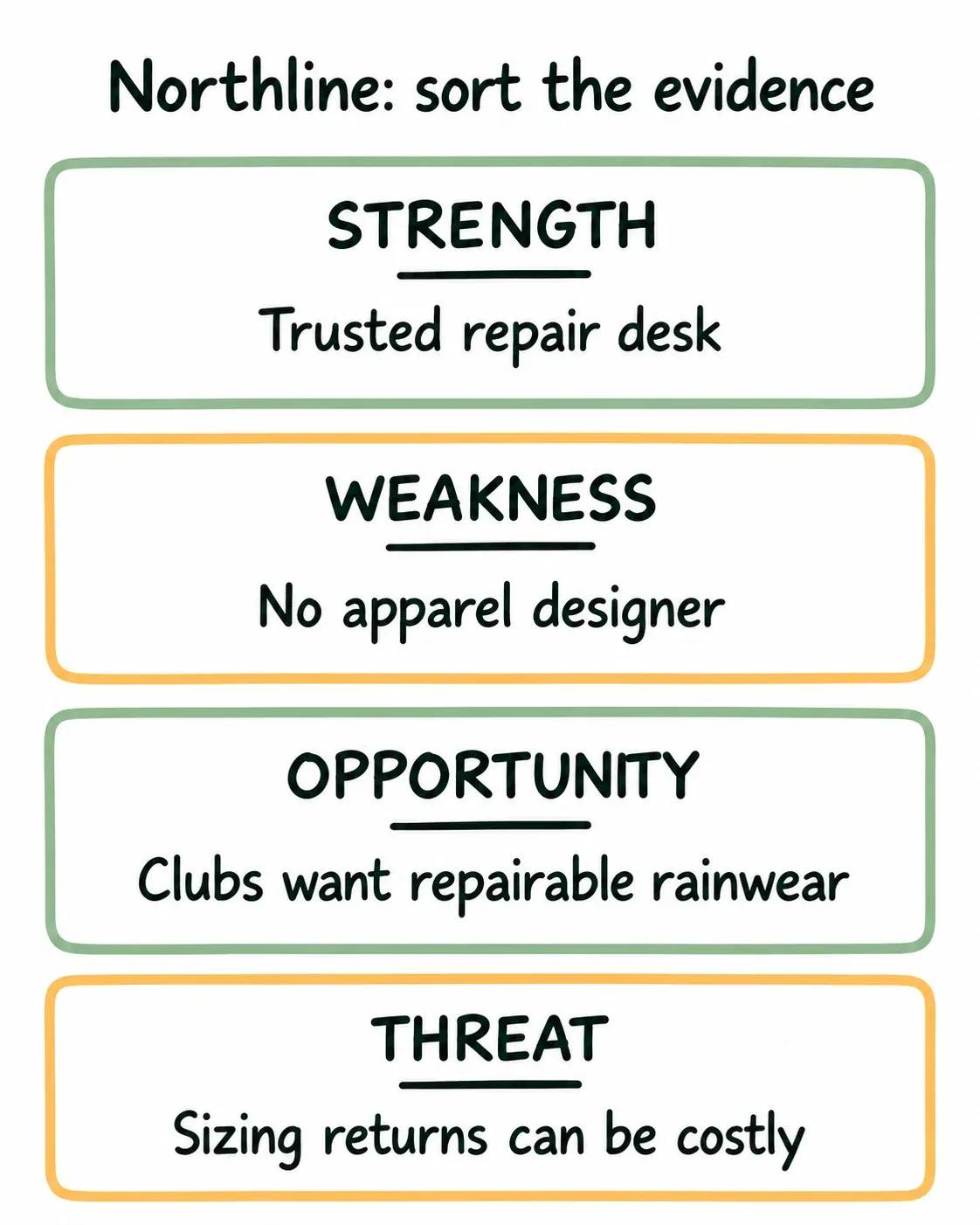
What earns a place in each box?
Two questions place each factor: where does it come from, and does it help or hurt? Strengths and weaknesses are internal; opportunities and threats are external. Keep the decision visible while you sort. A factor can help one plan and hurt another.
Strengths: something you can use
A strength is an internal advantage relevant to the choice. It might be a skill, location, customer relationship, or way of working that competitors would struggle to match.
For Northline, customers’ trust in the repair desk could help sell repairable rainwear. “We care about quality” is less useful. Almost every competitor can say that, and saying it does not establish an advantage.
Ask: if this strength disappeared, would our decision change? If the answer is no, it may be a compliment rather than a strategic factor. Strengths are also comparative: service that merely matches every serious rival is a requirement to compete, not necessarily a reason to win.
Weaknesses: something that constrains you
A weakness is an internal limit that gets in the way of the decision. Northline has no apparel designer and little experience handling size-related returns. Those gaps matter when launching a jacket, even if they barely matter when selling another brand’s hiking poles.
Write weaknesses plainly enough that someone could investigate them. “Our digital presence needs improvement” invites a vague project. “Customers cannot check sizes or start returns easily online” points toward specific work.
Avoid disguised boasts such as “we are too ambitious.” The matrix is allowed to contain uncomfortable information. That is part of its job.
Opportunities: an opening outside the business
An opportunity is an external condition the organization might use. Northline’s local hiking clubs have asked for repairable rainwear, and a small factory is willing to make a short run.
Neither condition proves demand. They create a plausible opening to test. “Grow revenue” is a goal, not an opportunity. “Club members are looking for a repair option that existing jackets lack” describes a possible opening, provided the evidence supports it.
Keep the opening separate from your proposed response. The factory’s availability is external. Signing a production contract is something you might do about it.
Threats: outside pressure that could hurt
A threat is an external condition that could damage the choice. Established outdoor brands already have credibility in jackets. Customers may expect easy returns. A leaking product could spread bad news faster than the repair desk can fix it.
A competitor’s name alone is not an explanation. Say how the competitor affects this decision: lower prices, wider distribution, better fit information, or an existing repair service.
Some factors can move between boxes as conditions change. A trusted repair reputation helps the launch, but a serious quality failure could put that reputation at risk. Record the condition rather than forcing an eternal label onto it.
Turn the boxes into a choice
The strategic work happens between the boxes. A strength meeting an opportunity suggests a possible move. A weakness meeting a threat shows where that move could fail.
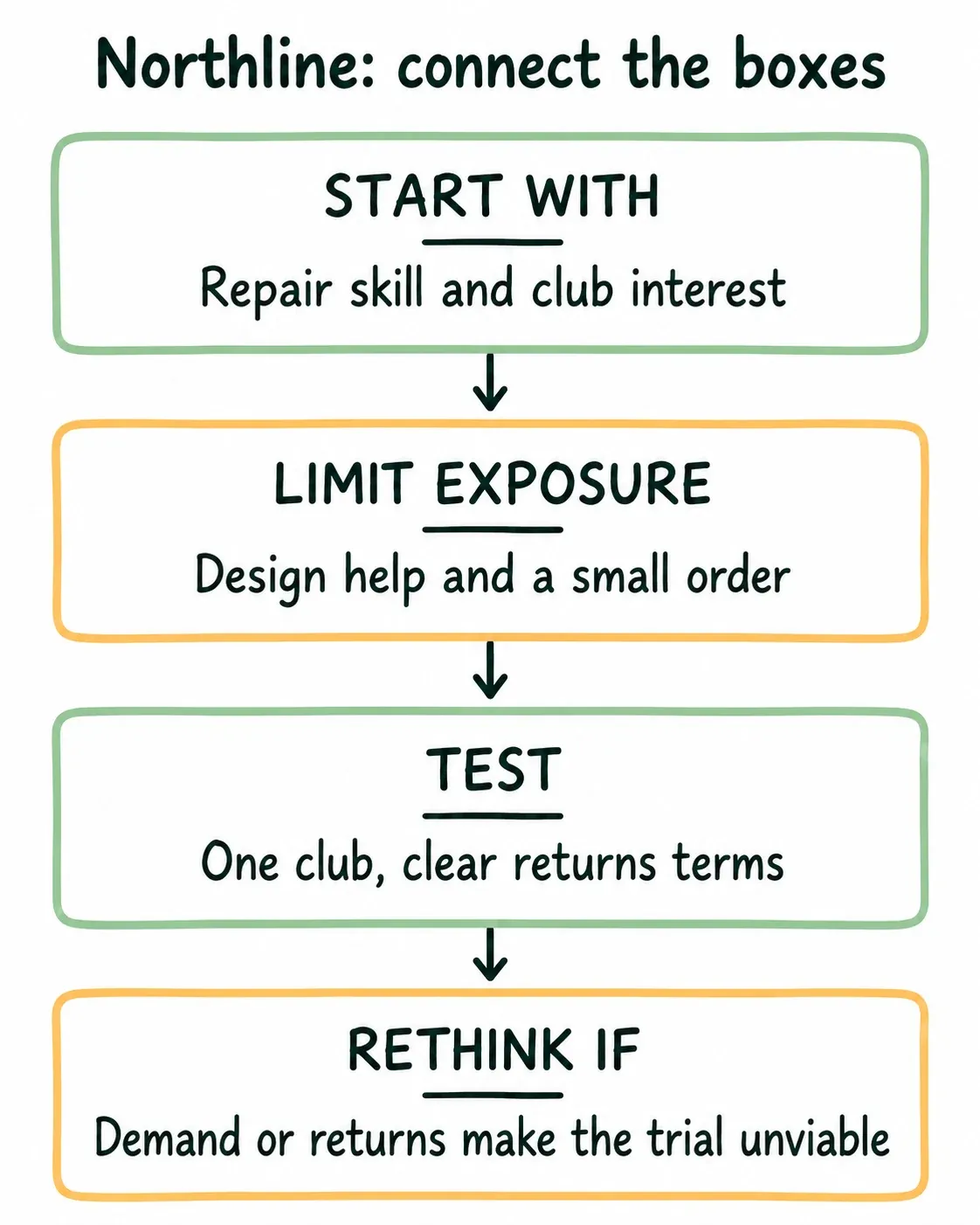
Northline’s repair desk and the clubs’ interest suggest a small trial. Its missing design skill and the cost of sizing returns argue against a full launch. A limited order for one club, with expert design help and an agreed returns process, becomes an option worth investigating.
Other pairings help too. A strength can defend against a threat: Northline’s repair capability could support a service that larger brands struggle to offer locally. A weakness beside an opportunity can suggest partnering before investing: borrow design expertise rather than pretending the team already has it.
The framework has not proved that the trial will sell. It has made the tradeoff specific enough to test. “Launch a brand” was an ambition. “Test a repairable jacket with one club before committing to stock” is a decision someone can organize.
Make the next commitment small enough to learn from
The four lists now point toward a specific option: design help, one club order, and clear returns terms. Before ordering stock, Northline should find out whether club members will commit to the actual offer and whether the small run can be delivered responsibly.
If fitting and returns make even that trial unviable, the answer may be a service partnership rather than a jacket brand. A useful SWOT makes that change of direction easier to explain. It does not obligate the team to launch something because the opportunity box looks promising.
Run a useful SWOT session
The following working method is FrameworkWorld’s recommendation, rather than a claim about one official version of SWOT.
- Write the decision and horizon. For Northline: whether to launch a house-brand shell within twelve months. Keep this sentence above the matrix.
- Set the boundary. Name the company, product, or market being examined. A parent company’s capability may not be available to a small division on the proposed timetable.
- Bring evidence before opinions. Customer requests, repair records, costs, supplier conversations, and observed competitor offers are better inputs than adjectives.
- Sort and challenge. Ask where each factor comes from, how it affects the decision, and what supports it. Label assumptions openly.
- Keep the decisive few. Combine duplicates. Do not make every box equally long. One serious weakness can matter more than six modest strengths.
- Write two or three options. Each should connect specific factors and name an action. Include waiting, partnering, or stopping where those are sensible choices.
- Choose the next evidence. Assign an owner to the uncertainty most likely to change the decision. Record when you will review it.
In Northline’s session, a disagreement about “strong demand” should lead to a question about actual club commitments. It should not end with averaging everyone’s enthusiasm.
An outsider can help challenge a favored plan. The sponsor may hear praise for the repair desk and infer demand for jackets. Someone else should be free to ask whether customers trust Northline to repair a jacket more than to design one.
Keep the analysis honest
A long list can hide an absent decision. Test every entry with “so what?” If removing it leaves all the options unchanged, it probably does not belong on the working matrix.
The boxes do not carry equal weight. SWOT supplies categories, not a scoring system. A legal or operational barrier cannot be cancelled out by a larger number of positive notes. Discuss severity, evidence, and the ability to respond.
The matrix can go stale. A supplier withdrawing or a trial revealing high returns changes the situation. Date the analysis and revisit it when a relevant fact changes, rather than treating it as a permanent company portrait.
Bias survives the diagram. Teams can word every threat as manageable and every strength as unique. Preserve contradictory evidence and invite someone other than the proposal’s sponsor to challenge the interpretation.
SWOT’s origin is disputed in public accounts. You do not need a neat inventor story to use the common four-part scan. You do need clear evidence and a bounded choice.
When a different tool helps more
Use SWOT early in a strategic choice when internal capabilities and outside conditions need to be considered together. Market entry, a new product line, and a partnership decision are reasonable fits.
Use Porter’s Five Forces when “competition” is doing too much work in the threats box. It explains industry pressure from buyers, suppliers, entrants, substitutes, and rivals.
Use PESTEL Analysis to explore broader external changes before selecting the opportunities and threats that matter. Use RICE for a narrower comparison of scoped product ideas competing for the same team.
A financial forecast, customer interviews, and operational planning may still be needed after the matrix. Northline’s next useful output is a testable launch option with someone responsible for learning whether it works.
Sources and further reading
- SWOT’s origin is disputed in public accounts, so this article does not attribute the framework to a single inventor. The method above is an editorial explanation of the commonly taught four-part scan.
- For industry structure, read Michael E. Porter, “The Five Competitive Forces That Shape Strategy,” Harvard Business Review, January 2008: hbr.org/2008/01/the-five-competitive-forces-that-shape-strategy.
- Harvard Business School’s Institute for Strategy and Competitiveness summarizes the same five forces: isc.hbs.edu.