Which outside changes could alter your decision?
Elm Parcel is ready to discuss vehicles for a new refrigerated route. Then a colleague mentions a proposed access restriction. Another asks whether charging is available on the route. A third asks what happens during a heatwave. The vehicle decision suddenly depends on much more than the vehicle catalogue.
Elm Parcel is a hypothetical delivery business considering refrigerated service in a second city. Every policy development, customer conversation, forecast, and operating detail below is invented; none describes an actual city.
PESTEL scans political, economic, social, technological, environmental, and legal influences around a decision. PESTLE is another ordering of the same categories. CIPD uses PESTLE and calls the social lens sociological; the purpose is the same.
Trace one outside change to the decision
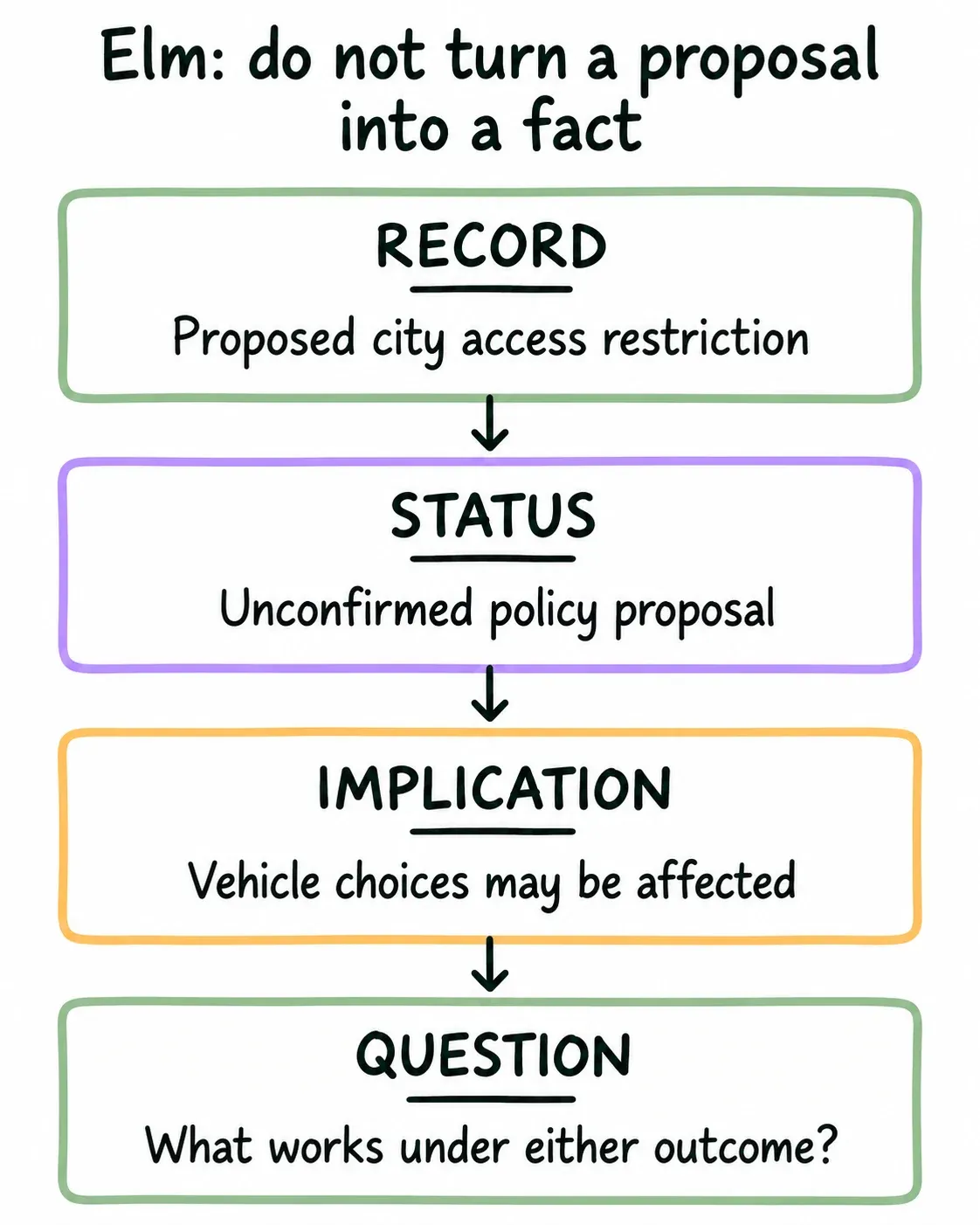
Elm records the access restriction as a proposal. That one word matters: a proposed rule creates uncertainty; it is not an enacted ban. The useful next question is which equipment choices remain workable under either outcome.
The same discipline applies across the scan. A cost forecast, a customer request, and a confirmed infrastructure limit are different kinds of evidence. Keep their status attached as the team works through the six lenses.
The scan identifies external assumptions worth checking. It does not predict events.
What the six letters ask you to examine
The six lenses surround one bounded decision. Their outputs should become a short list of relevant changes, not six equally long lists. An empty category is acceptable when the team has checked it and found nothing material.
Political covers government priorities, stability, trade policy, and other political influences. Economic covers conditions such as borrowing costs, purchasing power, and exchange rates. Social examines changes in population, expectations, and behavior.
Technological asks what changes in tools or infrastructure could alter delivery or demand. Environmental considers physical conditions and environmental pressures. Legal covers rules and obligations that affect the decision.
These are organizing lenses, not mutually exclusive causes. A proposed environmental rule may have political, legal, and cost implications. Keep one evidence record and describe those connections instead of counting the same issue three times.
From a headline to a decision
A useful scan connects an external development to an exposure. “Technology is changing” says little. “Our service depends on a platform whose announced interface change could interrupt customer imports” identifies a mechanism worth investigating.
FrameworkWorld recommends recording five things for each material issue: the source and date, what is known, what remains uncertain, the effect on this decision, and a trigger for review. Separate an enacted rule from a proposal and a measured trend from a forecast.
This discipline also keeps the scan manageable. If no plausible change in the factor would alter the decision, it probably belongs in background reading rather than the working shortlist.
Separate importance from certainty
Two issues can deserve attention for different reasons. One may be likely but easy to handle; another may be uncertain but capable of stopping the whole plan. Combining both into a single confident score can hide the difference.
Ask first what would change if the issue developed as feared or hoped. Demand, cost, access, and the ability to deliver are useful starting points. Then ask how much evidence supports that possibility and what is still unknown.
A proposed restriction deserves different wording from an enacted requirement. Keep the issuing body, publication date, and status attached to the note. For forecasts, retain the assumptions and range rather than copying only the most convenient headline number.
Also check what your team can change. It may be unable to influence a city’s decision, but it could choose equipment useful under either outcome. That converts an external uncertainty into a practical comparison of options.
The aim is to shorten the list of assumptions on which a large commitment depends. Keep an issue on the working shortlist when resolving it could change the action. Interesting news that cannot affect this choice can remain background reading.
Build Elm’s monitoring sheet
The team records a proposed city access restriction under political and legal influences. Because it is only a proposal, the team does not treat it as a confirmed ban. It asks which vehicle choices would remain useful under either outcome.
An uncertain electricity cost forecast raises an economic question about charging costs. Interviews suggesting narrower delivery windows raise a social question about customer demand. Charging coverage is a technological dependency, while heat exposure creates an environmental operating concern.
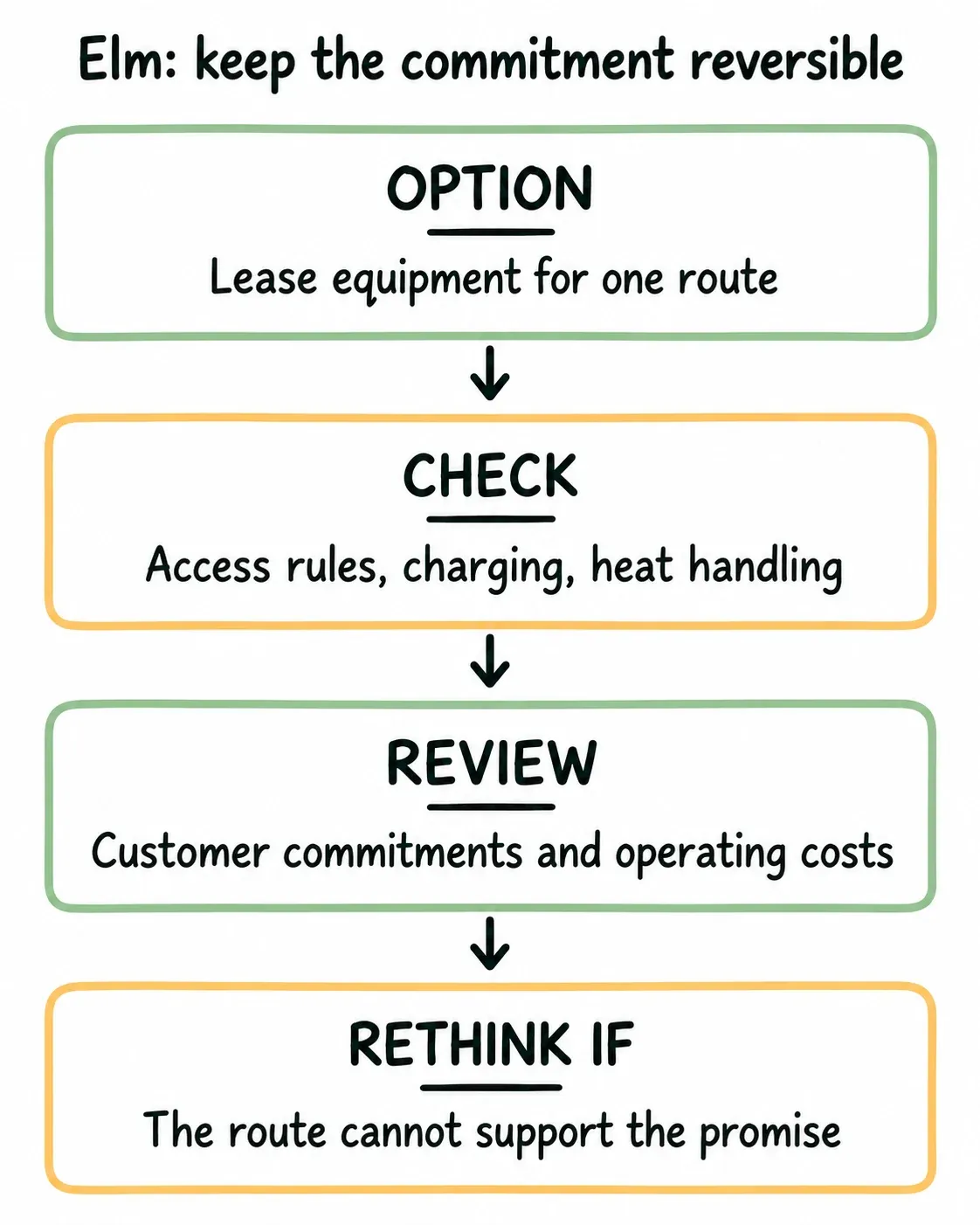
The scan changes the choice from buying a full fleet immediately to testing one route with leased equipment. Before the pilot expands, the team will review confirmed access rules, customer commitments, and observed operating costs. One owner watches the city’s published decision timetable; another gathers route evidence.
The framework did not discover that leasing is always better. It helped the team find which assumptions made an irreversible purchase premature.
Give the pilot a small monitoring sheet
| Hypothetical issue | Lens | What remains uncertain? | Decision or review trigger |
|---|---|---|---|
| Proposed city access restriction | Political / legal | Final wording and timetable | Review the published decision before expansion |
| Charging availability | Technological | Coverage on the intended route | Check the actual route before equipment choice |
| Heat exposure | Environmental | Performance in operating conditions | Test handling before accepting a wider service promise |
| Customer delivery windows | Social | What customers will commit to | Confirm the windows in pilot agreements |
The table is an invented teaching example. It describes no city’s actual rules or infrastructure. A single issue can span lenses; keep one evidence record instead of counting it twice as two independent threats.
Elm also assigns owners. One person watches the published access decision, another checks charging on the candidate route, and operations evaluates the pilot’s handling requirements. Monitoring “the environment” is too broad for anyone to know what to do next.
Make the trigger observable. “Revisit if things change” depends on someone noticing and remembering. “Review before expanding when the city publishes its decision” links a concrete event to a commitment.
Finally, compare options under more than one plausible future. If leased equipment works under both access outcomes, that flexibility may be valuable. It still has a cost and must be assessed against the actual alternatives. PESTEL identifies that conversation; it does not establish that leasing is the best financial choice.
Update the sheet when evidence arrives, and remove issues that no longer affect the decision. A scan that only grows will eventually become an archive rather than a working tool.
Link the scan to a pilot and a review trigger
Elm can lease equipment for one route while it gathers evidence about customer commitments, operating cost, and handling conditions. That preserves flexibility, but leasing still has costs. The scan creates a comparison worth evaluating, rather than proving a financial answer.
Before expansion, the team reviews the published access decision and the route evidence. If the equipment cannot deliver the promised service in those conditions, it changes the equipment, scope, or commitment. “Keep watching the news” would not be a sufficiently clear operating plan.
How to run the scan
- Write the decision, geography, customer group, and time horizon. A scan for one city next year differs from a worldwide five-year review.
- Gather current evidence across the six lenses. Prefer official statistics, regulator publications, and direct technical documentation for the relevant claims.
- Write the causal link between each development and demand, cost, delivery, or permission to operate.
- Discuss materiality and uncertainty separately. A poorly understood issue may still be serious enough to investigate.
- Compare options against the shortlist. Identify what can be changed now and what depends on new evidence.
- Assign an owner and review trigger to unresolved issues. Stop expanding the list once additional entries no longer change the options under consideration.
For consequential legal or financial decisions, the scan identifies questions for qualified specialists. A category label does not establish whether a particular rule applies or whether an investment is affordable.
Common mistakes and limits
Do not turn a possibility into a certainty through confident wording. Keep the source’s status visible. Likewise, avoid assigning precise probabilities unless you have a defensible method for them.
A PESTEL scan can miss abrupt changes and can overemphasize recent news. Invite someone to challenge the favored plan, and record evidence that points in the opposite direction. The scan describes external influences; it does not show whether the organization has the skills or money to respond.
Use scenario planning when several interacting uncertainties require different operating plans. PESTEL can provide inputs, but a list of factors is not itself a set of scenarios.
Related frameworks
SWOT Analysis combines internal strengths and weaknesses with external opportunities and threats. Feed the most relevant PESTEL findings into its external side, then check whether the organization can respond.
Porter’s Five Forces examines industry structure. Use it when a broad development matters because it changes supplier power, buyer power, substitutes, entry, or rivalry.
Sources and further reading
- Chartered Institute of Personnel and Development, PESTLE analysis, March 21, 2025, accessed October 21, 2026. Institutional explanation of the six external influences. The evidence record, review process, and fictional pilot are FrameworkWorld’s applications.