The loudest request is not always the most important
The ticket queue has stopped assigning owners. A colleague needs slides reformatted before lunch. The monitoring review has already slipped twice. Alder Service’s operations lead opens the calendar and finds a familiar problem: several things want the same hour, and being loud has become the unofficial selection process.
Alder Service is a hypothetical support operation. Its Monday workload, requests, and decisions below are invented to show the method.
The Eisenhower matrix separates urgency from importance. Urgency asks how soon action is needed. Importance asks what the work protects or improves in relation to real goals and obligations. The University of Central Florida presents the familiar four-quadrant layout under this name.
This guide explains the commonly used layout without attributing invention of the four-box diagram to Eisenhower. FranklinCovey teaches a related urgency–importance Time Matrix in its materials.
Write the consequence beside the deadline
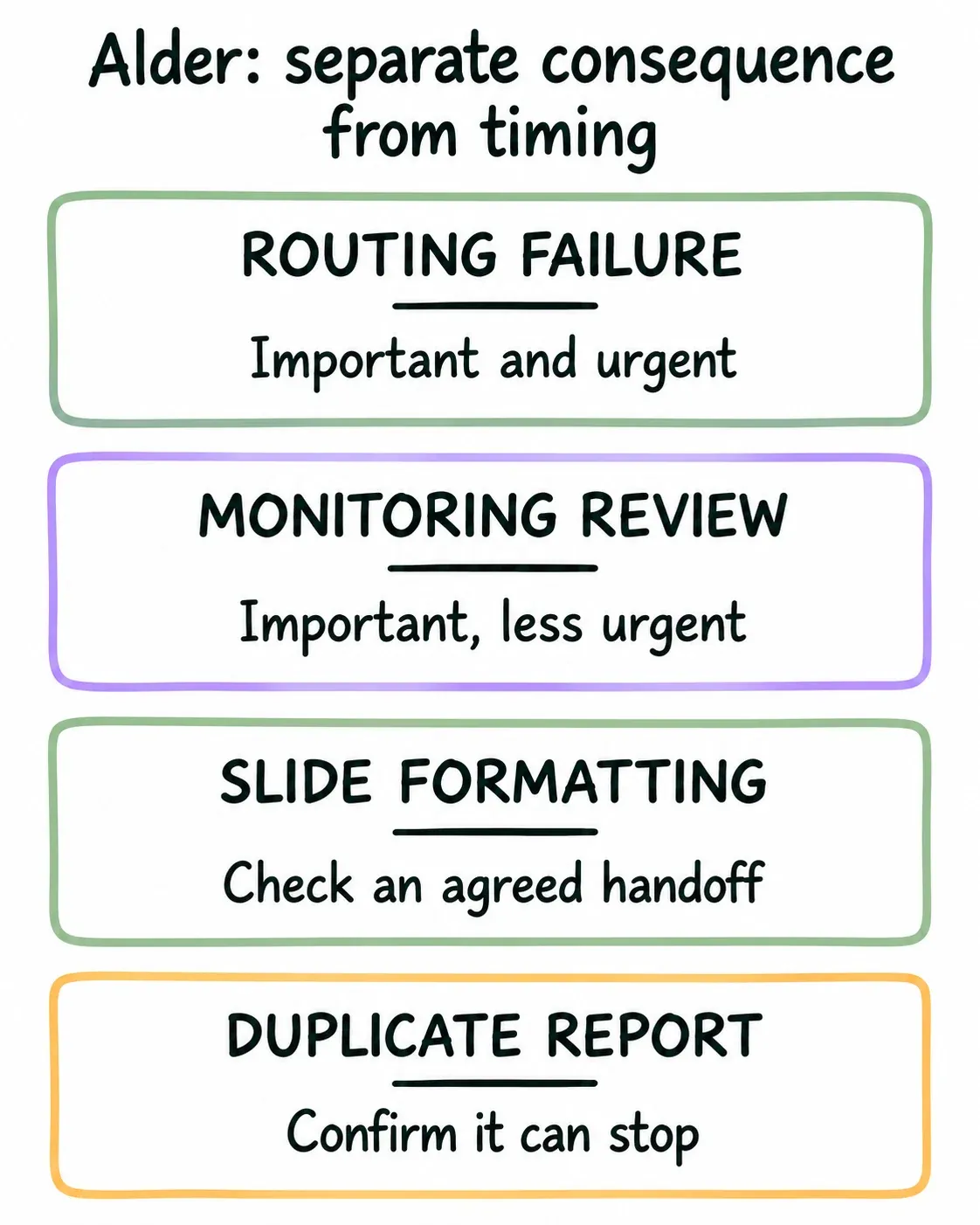
The routing failure prevents customers from getting an owner, so it needs an immediate response. Monitoring protects against a repeat, even though nobody is currently shouting for it. Those tasks are connected, but they should not compete under the same deadline.
For the slides and recurring report, the lead first checks who needs the result. A less important request still deserves an honest agreement. The board is a starting placement; the real output will be an owner, reserved time, an agreed handoff, or permission to stop.
What to do with each kind of work
Importance × Urgency
Important · Urgent
Do in time
Act before a real consequence or deadline is missed.
Important · Not urgent
Schedule
Reserve time for preparation, prevention, and development.
Less important · Urgent
Consider delegation
Clarify the request and agree an appropriate owner or response.
Less important · Not urgent
Remove or limit
Check obligations before stopping or reducing the activity.
Read importance down the rows and urgency across the columns. The actions shown are starting choices: do, schedule, consider delegation, and remove or limit. Delegation requires a capable owner and an agreed handoff; it is not an automatic destination for everything you dislike doing.
Important and urgent: act in time to protect the outcome. Check the actual deadline and consequence. A customer-impacting failure and an emphatically worded request should not receive the same priority merely because both arrived today.
Important and not urgent: reserve time before the work becomes a crisis. Maintenance, coaching, and preparation often need a calendar commitment rather than another reminder.
Less important and urgent: question whether you need to be the person doing it. Clarify the request, negotiate the deadline, or arrange a handoff if another owner can handle it appropriately.
Less important and not urgent: remove, reduce, or consciously limit it. Rest and recovery are not automatically unimportant; judge their role in sustainable work rather than treating visible busyness as the goal.
These action checks are FrameworkWorld’s suggested application of the two axes. Importance is relative to real obligations, not just the preferences of whoever is sorting the list.
Test the deadline before accepting the urgency
An urgent request should have a reason for its timing. Ask what happens if it is completed tomorrow, who depends on it, and when action becomes too late. “The requester would prefer it today” and “customers cannot receive support until this is repaired” imply different consequences.
Importance also needs a reference point. Start from agreed outcomes, responsibilities, and commitments. Personal preference alone can make quiet work for other people disappear into the supposedly unimportant boxes.
Some work becomes urgent because earlier important work was repeatedly postponed. That is a reason to protect prevention after restoring service, rather than a reason to blame every emergency on the person handling it.
Tasks can move between quadrants as time passes or evidence changes. A planned maintenance check may become urgent when a fault appears. Review the list rather than treating placement as a permanent property of the task.
Finally, account for duration. Two equally important urgent actions may require different responses if one takes ten minutes and the other needs a full day. The matrix sorts by timing and consequence; effort and dependencies still need to enter the schedule.
Give Alder’s four tasks a concrete response
A failed assignment rule is preventing new tickets from reaching an owner. Restoring the routing is important and urgent. Reviewing the rule’s monitoring is important but can be scheduled after service is restored; ignoring it would make another interruption more likely.
A colleague asks the lead to reformat a routine presentation before lunch. The lead checks who needs it and why. Once the requester confirms that another team member can use the existing template, they agree on a handoff rather than leaving the request unanswered.
A recurring report duplicates a dashboard nobody uses in the review meeting. The lead confirms with its recipients that the report can stop. That removes work rather than delegating unnecessary work to someone else.
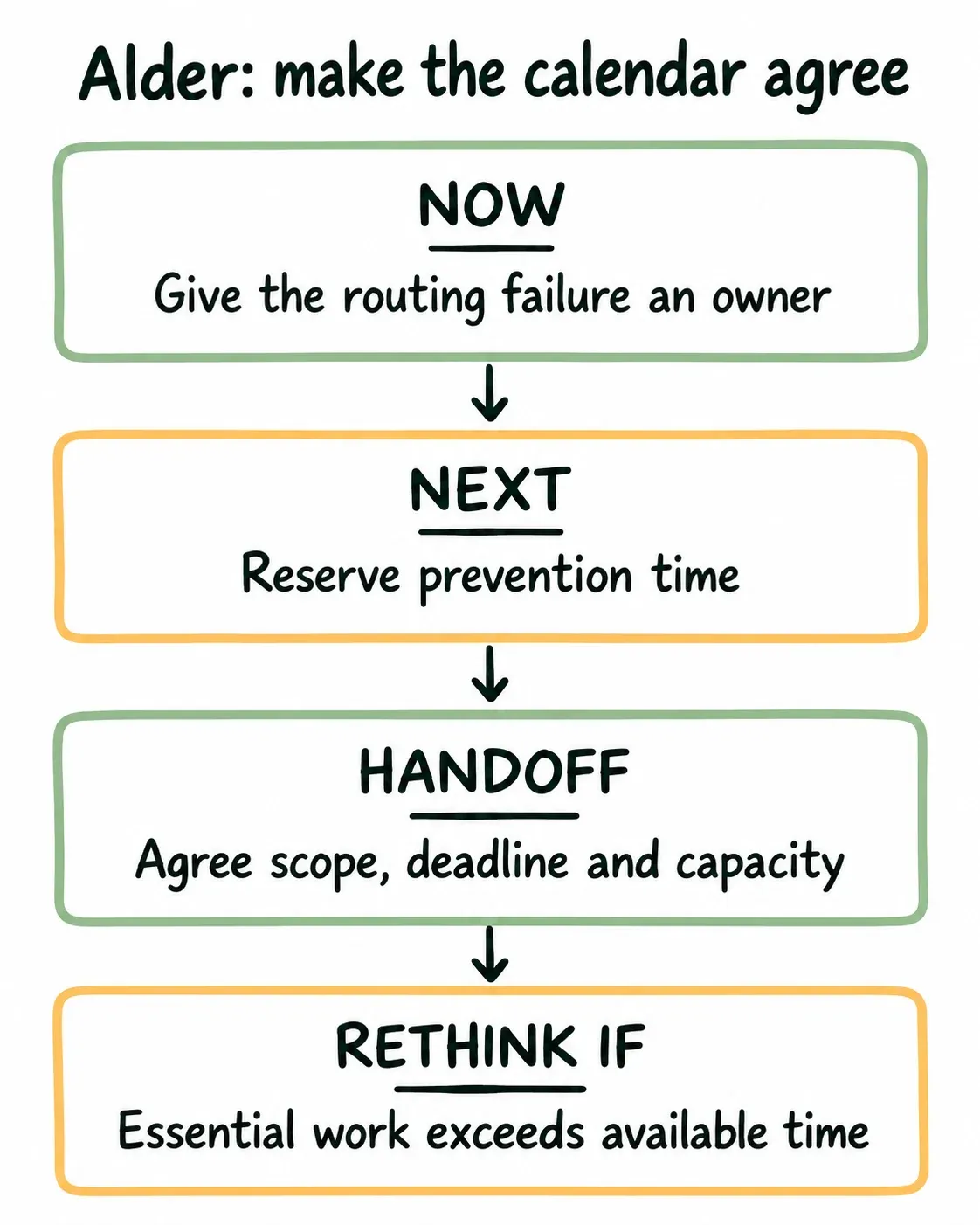
The outcome is not a perfect four-box slide. The immediate issue has an owner, prevention has reserved time, the presentation has an agreed handoff, and one recurring obligation has been deliberately retired.
Turn placement into a real calendar decision
| Alder’s hypothetical work | Placement | Concrete response |
|---|---|---|
| Restore failed ticket routing | Important and urgent | Assign the immediate response |
| Review routing monitoring | Important, not yet urgent | Reserve a follow-up block |
| Reformat routine slides | Less important to the lead, urgent | Agree an appropriate handoff |
| Duplicate recurring report | Less important and not urgent | Confirm with recipients, then stop it |
The third row needs particular care. Work that is less important for this lead may still matter to its requester. Delegation means an agreed transfer to someone with capacity and context, not dropping a task into another person’s day.
The handoff should name the expected result, deadline, and support available. If there is no suitable owner, the lead may need to negotiate the request rather than pretend a box has solved it.
Protect the second row with a real appointment. An unscheduled intention to investigate monitoring is likely to lose again to today’s visible requests. If the service incident consumes that reserved time, rebook the work explicitly instead of letting it vanish.
At the end of the week, examine repeated emergencies. Were the same systems failing? Were deadlines genuinely external or repeatedly created by late requests? These patterns point toward a process change that daily triage alone cannot provide.
Also check the total. If the essential work exceeds the team’s time, no rearrangement can make it all fit. Bring the conflicting commitments to the people who can change scope, timing, or staffing. The useful output is an honest set of agreements, including what will wait.
Check whether the calendar can keep the agreement
Alder’s lead gives the incident an owner and reserves a prevention block. The slide handoff includes a deadline and a person with capacity. The duplicate report stops only after its recipients agree.
At week’s end, the lead checks whether prevention happened and why any emergency repeated. If essential commitments exceed the hours available, the next step is a scope, timing, or staffing decision. Moving the same overloaded list between boxes cannot make the week longer.
Triage a working week
- Write down the outcomes, standing obligations, and commitments the week must protect. Include work whose failure would affect someone else.
- Break large projects into actions that can be scheduled or assigned. “Improve onboarding” is too broad to place meaningfully.
- For each action, record the consequence of delay and the last responsible time to act. Challenge urgency that has no concrete reason.
- Place the work in the four groups. If colleagues disagree on importance, resolve the outcome or obligation before debating the box.
- Reserve time for important work, leaving room for plausible interruptions. Check that the total commitments actually fit.
- Agree on any handoff: owner, expected outcome, deadline, and available support. Remove work only after checking obligations and dependencies.
- Review the list when circumstances change. Repeated emergencies are a signal to investigate the system producing them.
If the important work exceeds capacity, stop optimizing the arrangement of boxes. Renegotiate scope, deadlines, or staffing with the people who own those commitments.
Common mistakes and limits
Do not equate importance with seniority. A quiet request can involve a material customer or team commitment. Likewise, an apparently low-value task may be a prerequisite for something critical.
The matrix does not rank every task within a quadrant, estimate effort, or account for all dependencies. Add these checks before making a schedule. A long list of important items still requires tradeoffs.
Use a delivery-planning method when several teams must coordinate scope and milestones. Use backlog scoring when comparing many possible investments. The matrix is most useful for deciding how to handle work that has already reached your attention.
Related frameworks
SMART Goals makes a result clear enough to review. Use it when importance is disputed because the underlying goal is vague.
RACI Matrix clarifies involvement and ownership across roles. Use it when delegation stalls because people disagree about who owns the work.
Sources and further reading
- University of Central Florida, Eisenhower Matrix: Urgent vs. Important, accessed October 21, 2026. Institutional guide to the four quadrants.
- FranklinCovey, Act on the Important, Don’t React to the Urgent, accessed October 21, 2026. Official explanation of its urgency–importance approach. Time Matrix is a FranklinCovey trademark; FrameworkWorld is independent and this article does not replace its training materials.