What would “better onboarding” actually look like?
Cedar Support agrees that onboarding should be better. The proposed solutions arrive immediately: write a handbook, record more videos, answer fewer questions. The onboarding lead pauses the list. What should a new colleague actually be able to do when this work succeeds?
Cedar Support is a hypothetical support team improving onboarding. The four colleagues, five practice scenarios, date, and assessment arrangements in the walkthrough are invented teaching details.
SMART is a checklist for making a goal clear enough to act on and review. This guide uses the modern expansion specific, measurable, achievable, relevant, and time-bound, as used in the CDC’s action-plan guidance. Other expansions exist; agree on the version your team is using.
Choose the capability before choosing the metric
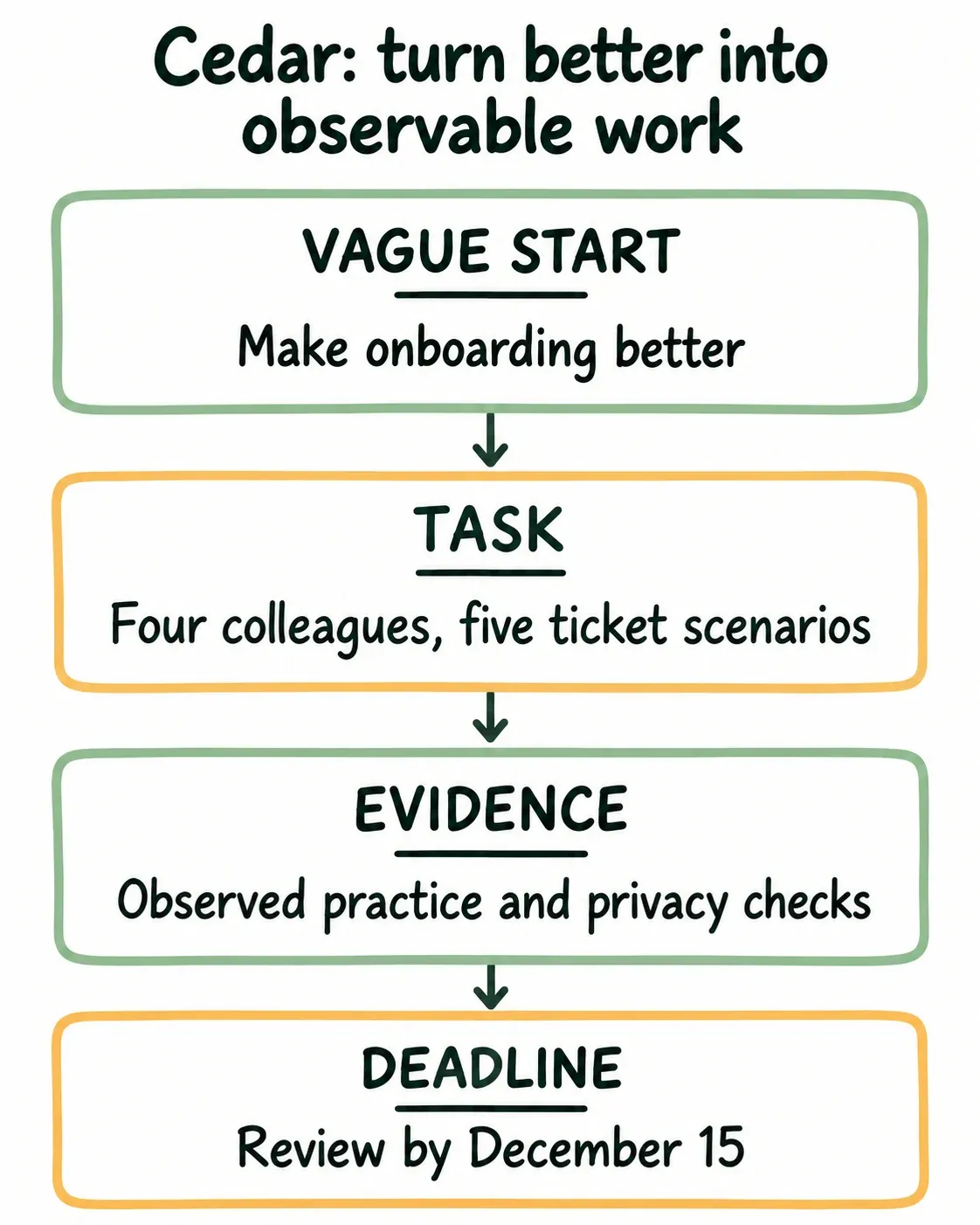
Cedar picks a bounded capability: handling five common ticket scenarios independently in supervised practice, including the required privacy checks. That is more inspectable than “confidence,” and more useful than counting how many handbook pages the team publishes.
The draft concerns four new colleagues and a review by December 15. Those numbers make this case concrete. They are not a recommended quota. The team must still check whether practice access, coaching time, and a fair assessment make the commitment feasible.
What each check adds
Read the five checks as questions about one goal. They are not five separate goals or a score in which four correct answers compensate for one missing answer. A measurable but irrelevant target still sends effort in the wrong direction.
Specific
State what will change and for whom. Replace a broad aspiration with a result that colleagues can recognize. Specific does not mean dictating every step; an experienced person can choose the method within clear boundaries.
Measurable
Name the evidence of progress or completion. A count can help, but an agreed demonstration can also be observable. Define what gets counted and where the information comes from.
Achievable
Check the goal against the available time, skills, resources, and dependencies. A target can be demanding without relying on an unavailable system or another team’s unagreed commitment.
Relevant
Explain why the result matters to the broader purpose. This is the check that stops a convenient metric from becoming a goal merely because it is easy to track.
Time-bound
Set a deadline or review window. Include enough time to observe the outcome, rather than selecting a date only because a planning cycle ends then.
These are the checklist’s basic meanings. The review method and management advice below are FrameworkWorld’s suggested application.
Measure the result you actually care about
A count is easy to write and sometimes easy to game. “Publish ten onboarding pages” measures output. It does not establish that a new colleague can handle a ticket. Choose the evidence that answers the underlying question.
For the fictional support team, an observed practice task can make independence visible. The team agrees the scenarios, required privacy checks, and what help is allowed before the session. Otherwise, two reviewers may watch the same work and reach different conclusions.
A baseline matters when the goal is a change from today. If you want to reduce an error rate, define the errors and measure the current rate first. If the first task is learning what happens today, make that measurement the immediate commitment rather than inventing a starting number.
Also choose a guardrail: an important condition the target must not sacrifice. A team trying to respond faster might track whether the response actually resolves the issue. Speed alone can encourage a quick but unhelpful reply.
These are editorial review practices alongside the five SMART checks. They help prevent a beautifully written target from directing the wrong behavior. The useful question is whether someone could meet the stated target while failing the purpose. If they could, revise the evidence or add the missing condition.
Write Cedar’s commitment and test its limits
After reviewing the work, the team drafts this goal: “By December 15, the onboarding lead will enable all four new support colleagues to complete the five standard ticket scenarios independently in a supervised practice session, with every required privacy check completed.”
The goal is specific about the group and task. Its evidence is a practice assessment, using a rubric agreed before the session. The training calendar includes access to the practice environment and time with an experienced coach, supporting achievability. Independence on common tickets explains relevance. December 15 sets the review deadline. The numbers and scenario are invented, not research findings.
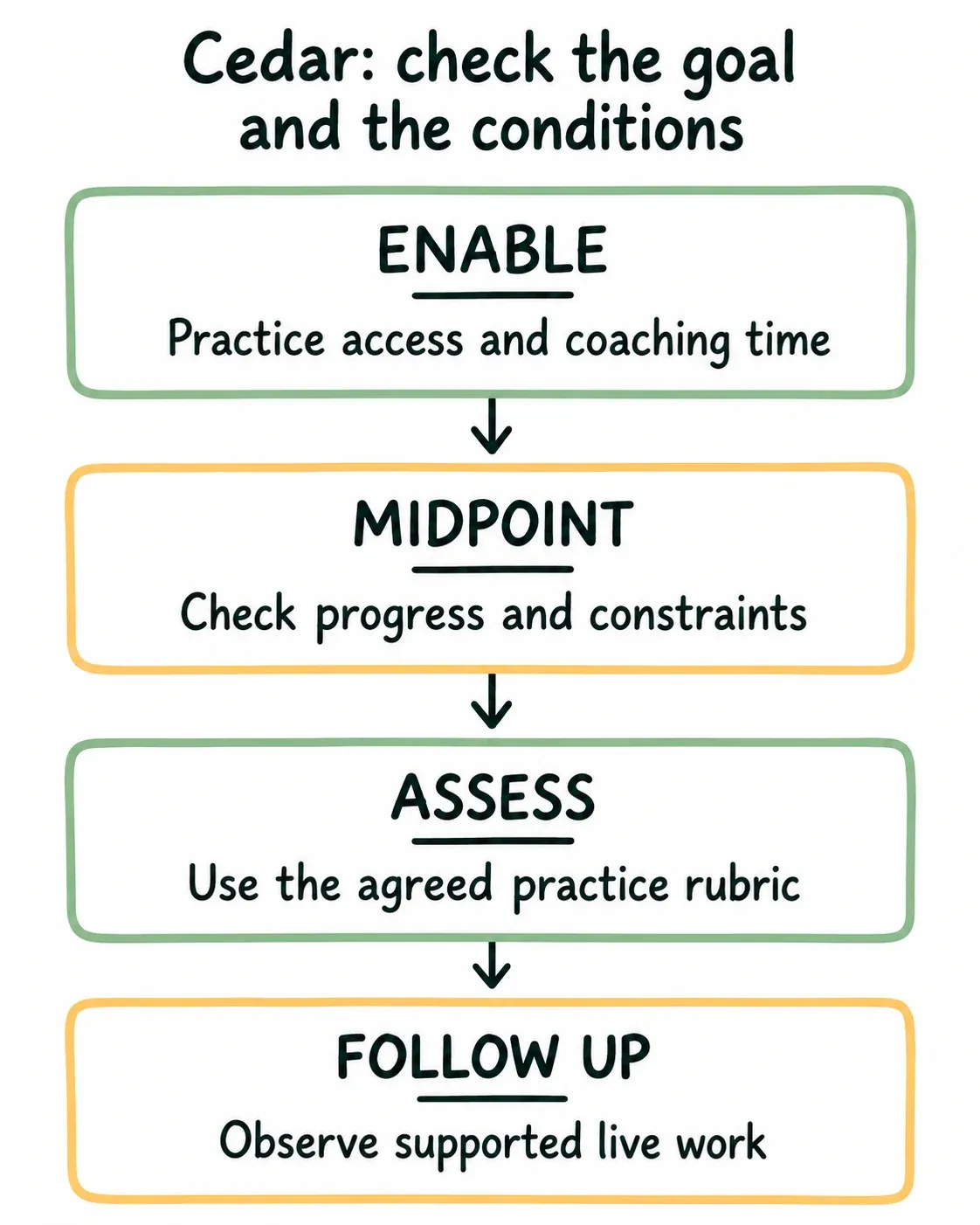
The manager also agrees that staff will not be rushed into handling unfamiliar live cases. A mid-point review checks whether the environment and coaching are available. If access is delayed, the team records the constraint and revisits the plan instead of quietly lowering the assessment standard.
The example measures a defined capability. It does not claim that passing the session guarantees good support in every situation. The next period needs observation of real work.
Trace each check through the example
| Check | Cedar’s hypothetical commitment |
|---|---|
| Specific | Four new colleagues complete five standard ticket scenarios |
| Measurable | An observed session using an agreed rubric |
| Achievable | Practice access and coaching time are available |
| Relevant | Colleagues develop independence on common work |
| Time-bound | Review by December 15 |
The numbers make this particular teaching example concrete. They are not recommended targets for every support team. Cedar should choose the scope from its work and available resources.
At the midpoint, the lead checks both progress and conditions. Have colleagues had access to practice? Are the examples representative? Is an unexpected difficulty showing that the training needs another step?
Suppose a practice environment becomes unavailable. The goal has not become irrelevant, but the original plan may no longer be achievable on the same terms. Record the constraint, agree a revised approach, and preserve the original commitment so the review remains honest.
Suppose everyone passes the practice session but struggles on live cases. That does not make the assessment worthless. It shows that its evidence covered only the defined scenarios. Cedar now needs a supported transition and observation of real work rather than claiming universal readiness.
A review should therefore ask two questions: did the agreed result happen, and did it produce the useful change expected? The first checks delivery. The second checks whether the goal was a good one. Keeping both questions alive makes the next commitment better.
Review the result and what made it possible
Cedar checks practice access and coaching at the midpoint, rather than waiting until the deadline to discover that colleagues could not prepare. At the assessment, it uses the agreed rubric and records what each person can do.
Passing those scenarios establishes a defined capability in a defined setting. The next step is supported live work and observation. If the assessment succeeds but live work remains difficult, Cedar revisits the scope and training rather than stretching the result into a claim of universal readiness.
Write the goal, then challenge it
- Start with the problem. Describe the current situation and the people affected before choosing a target.
- Establish a baseline where comparison is needed. If none exists, make the first commitment a short measurement exercise rather than inventing one.
- Draft one sentence stating the result, audience, evidence, and deadline. Add the owner and review cadence beside it.
- Ask the owner what would make the goal unattainable. Resolve critical dependencies or change the target before agreement.
- Check the relevance with the team. Explain what improves if the goal is reached and what should not be sacrificed to reach it.
- Agree when to review progress and when new evidence would justify revising the commitment. Record revisions so the original decision remains visible.
A reusable starting sentence is: “By [date], [owner or team] will achieve [observable result] for [group], measured by [evidence].” The sentence is a drafting aid, not a substitute for checking feasibility and relevance.
When to use SMART goals
Use SMART when delegating a bounded result, agreeing a development objective, or turning a team priority into a reviewable commitment. It is useful when people currently disagree about what “done” means.
For uncertain discovery work, the immediate goal may be a learning result: finish an agreed set of interviews and present evidence for or against a hypothesis by a date. Do not demand a predetermined finding. The learning goal still needs a quality check so an interview count does not replace understanding.
Common mistakes and limitations
A precise target can be the wrong target. Faster ticket closure is not helpful if unresolved cases are simply closed early. Choose evidence that reflects the underlying result, and watch for behavior that improves the number while harming the purpose.
Do not confuse achievable with easy or with a manager’s optimism. Ask the person doing the work about capacity. SMART describes a commitment; it does not supply resources or resolve competing priorities.
Likewise, avoid using the deadline to conceal dependencies outside the owner’s control. Name those dependencies explicitly. Revising a goal because circumstances changed is different from rewriting it to hide a missed commitment.
Alternatives and related frameworks
Objectives and Key Results can help organize a broader objective and several measurable results. SMART is useful for checking an individual commitment’s clarity; it does not by itself align a whole organization’s priorities.
Situational Leadership asks what direction and support a person needs on a particular task. Use it after agreeing the goal, rather than assuming a clear target removes the need for coaching.
RACI Matrix clarifies who does the work, owns the result, contributes advice, and receives updates. Use it when several roles must cooperate on the goal.
Sources and further reading
- Centers for Disease Control and Prevention, SMART Framework, August 28, 2024. Institutional guidance for developing specific, measurable, achievable, relevant, and time-bound action plans.