A new target will not change the team by itself
Stonebridge’s manager announces that incident reviews must lead to better follow-through. Everyone agrees. Three weeks later, action lists are still unfinished. A stronger speech is available, but so is a harder question: what would the manager and team have to do differently for the stated purpose to become credible?
Stonebridge Software is a hypothetical team trying to improve incident reviews. Its manager, colleagues, missed actions, and proposed trial are fictional; no outcome is presented as a research finding.
Transformational leadership describes behaviors that build shared purpose, model standards, encourage new thinking, and support individual development. Mind Garden’s explanation groups these into the four Is: idealized influence, inspirational motivation, intellectual stimulation, and individualized consideration.
Make the invitation visible in everyday behavior
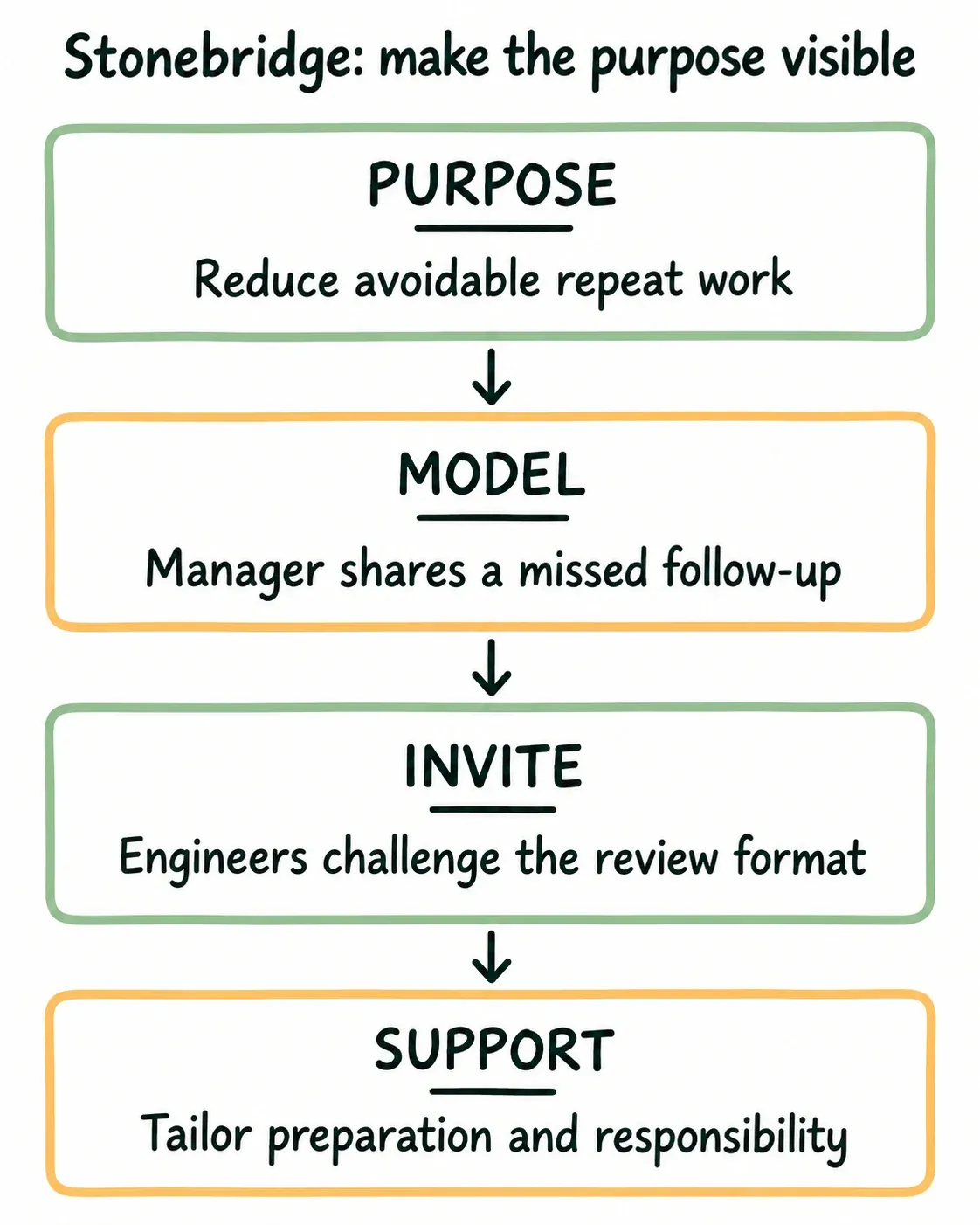
The manager starts by bringing her own missed follow-up to the review. She explains the purpose—less avoidable repeat work—and asks engineers to challenge the meeting format. A newcomer needs help with a timeline; an experienced colleague needs room to test a follow-up.
Those actions give the model something observable to discuss. They also expose contradictions: encouraging initiative while controlling every method, or promising learning while leaving no time for it. The next sections name the four behaviors and examine how they reinforce each other.
The four behaviors
Read the four components together. A shared purpose without support can become pressure. Encouraging new ideas while punishing disagreement makes the invitation hollow. The framework is more useful as a set of observable behaviors than as a description of charisma.
Idealized influence concerns acting as a credible role model. In a working team, ask whether the leader follows the same standards they request from others, especially when doing so is inconvenient.
Inspirational motivation concerns meaning and shared direction. The practical question is whether people can explain the intended change and why it matters, rather than merely repeat an ambitious slogan.
Intellectual stimulation encourages questioning assumptions and considering different approaches. Ask whether colleagues can challenge an established method without being treated as disloyal.
Individualized consideration attends to different development needs through coaching and support. Ask what each person needs to contribute, rather than assuming the same instruction or opportunity fits everyone.
The component names and basic meanings follow Mind Garden’s model explanation. The questions are FrameworkWorld’s management prompts; they are not items from a validated leadership questionnaire.
Make the four behaviors reinforce each other
A purpose becomes credible when the leader’s behavior supports it. If the manager asks people to discuss mistakes openly while hiding her own missed follow-up, the invitation has a visible limit. Modeling the standard makes the request easier to trust.
New thinking also requires a response when someone disagrees. Asking for ideas and then defending every detail of the original plan teaches people which answer was wanted. Invite a challenge to the method and give a reasonable alternative a way to be tested.
Individual support connects that invitation to people’s ability to act. A new colleague may need help preparing an incident timeline. An experienced colleague may need time and authority to test a different review format. Giving both the same pep talk is easier than meeting their different needs, but less useful.
Look for contradictions across the four behaviors. A compelling purpose combined with punishing workloads can turn inspiration into pressure. Personalized coaching combined with an unquestionable plan can make support feel conditional on agreement.
The component names come from the model. These checks are FrameworkWorld’s application to everyday management, not items from a formal assessment. Ask a colleague for a concrete example of your behavior rather than awarding yourself a score for good intentions.
Make Stonebridge’s change observable
The manager describes the purpose of the change as learning enough from failures to reduce avoidable repeat work. She models the standard by bringing one of her own missed follow-ups to the review instead of discussing only other people’s mistakes.
She asks engineers to challenge the proposed meeting format. One engineer suggests testing a shorter review focused on a single contributing condition and a follow-up that can be checked. The team agrees to try that format for the next suitable incidents rather than declare it a permanent solution immediately.
A newer colleague receives help preparing a timeline. An experienced colleague takes responsibility for testing whether the follow-up was effective. Individual support differs while the purpose stays shared.
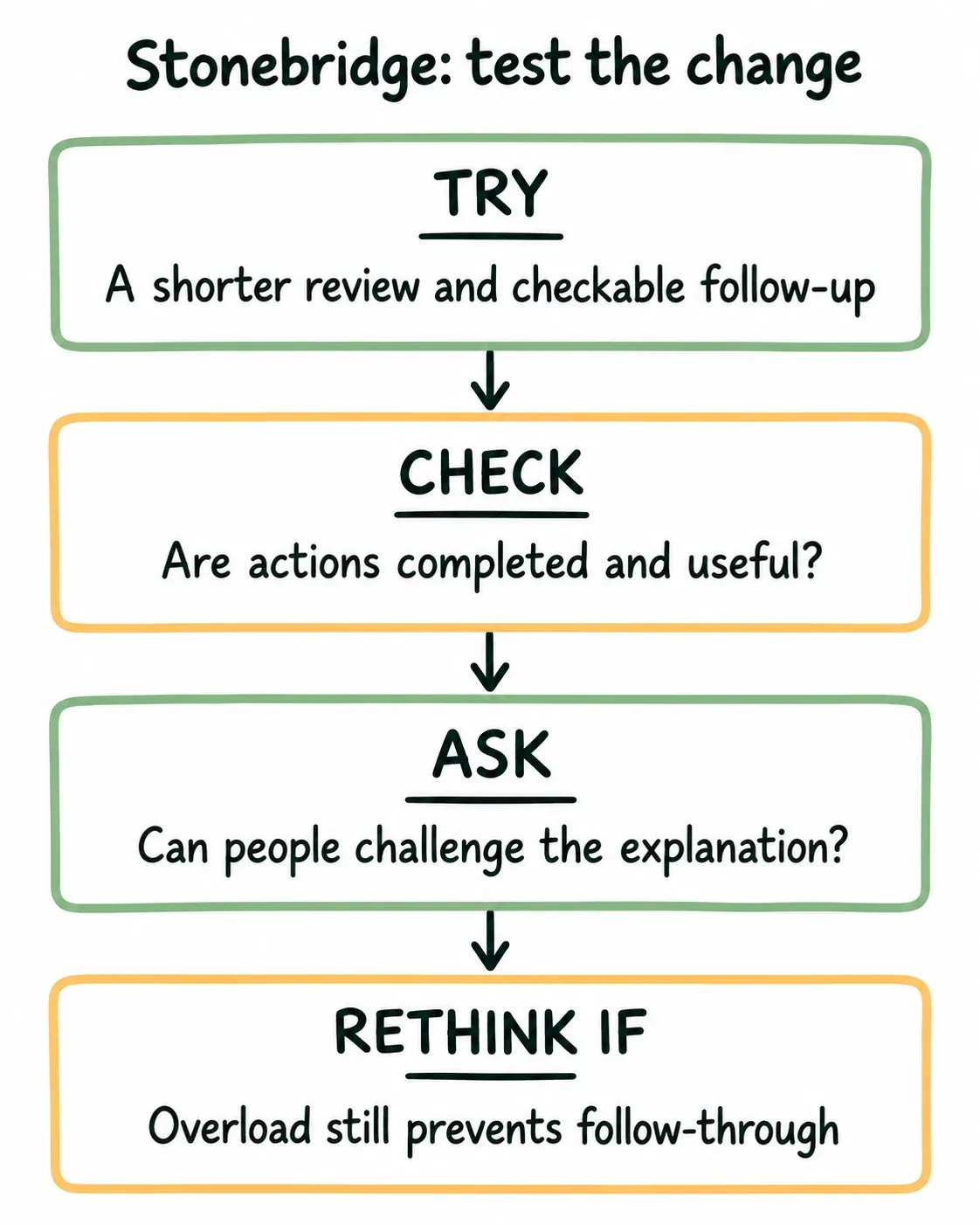
At the review date, the manager checks whether actions were completed and whether people could question the explanation of the incident. If the team is still overloaded, another speech about ownership will not fix the capacity problem. The manager must reduce conflicting work or adjust the commitment.
Put the change into observable behavior
| Component | Stonebridge’s hypothetical action | What to check later |
|---|---|---|
| Idealized influence | Manager brings her own missed follow-up | Does the same standard apply to her? |
| Inspirational motivation | Explain the purpose of reducing repeat work | Can colleagues explain the intended benefit? |
| Intellectual stimulation | Test an engineer’s alternative review format | Can people challenge it without penalty? |
| Individualized consideration | Tailor preparation help and ownership | Do people have the support and time needed? |
The table makes the behaviors reviewable without pretending to measure a personality. A manager can compare what she intended with what colleagues experienced.
For the first trial, Stonebridge chooses a small number of suitable reviews and an agreed way to check follow-up. It does not announce that a new format has transformed the culture before anyone has used it. A bounded experiment makes revision easier.
At the review date, ask what became easier and what became harder. Perhaps actions are clearer but still unfinished because the same engineers are handling urgent operational work. That finding calls for a capacity decision. Repeating the mission statement would leave the constraint untouched.
Also ask whether people could disagree with the manager’s explanation of an incident. Completed tasks are useful evidence, but they can coexist with a conversation in which junior colleagues stayed silent. A credible learning environment needs room to question the interpretation as well as execute the response.
Keep routine expectations alongside the change: owners, deadlines, escalation paths, and technical checks still matter. The four behaviors help people engage with a change; they do not replace the operating system that makes work dependable. Review both before attributing the outcome to the leader’s style.
Test the change without announcing a transformation
Stonebridge can try a shorter review with a checkable follow-up for suitable incidents. At the review date it asks whether actions were useful and completed, and whether people could question the incident explanation.
If engineers remain overloaded, the manager must change commitments or capacity. If junior colleagues stay silent, a tidy action list is incomplete evidence of a better learning environment. The trial should leave room for those answers; declaring success in advance would defeat its purpose.
Turn the model into a change conversation
- Name one change and the problem it should address. Explain what evidence suggests the current approach needs to change.
- State the purpose in terms the team can evaluate. Include constraints and tradeoffs so optimism does not conceal a missing resource.
- Identify one behavior you must model personally. Ask a colleague to point out when your actions contradict the stated standard.
- Invite a challenge to the proposed method. Give the team a bounded way to test an alternative and agree how to judge it.
- Discuss support individually. Check skills, available time, confidence, and access to the work rather than inferring needs from job title.
- Agree on observable progress and a review date. Ask what is becoming harder as well as what is improving.
- Revise the approach if the evidence or team capacity contradicts the original plan. Explain the revision publicly enough that people understand the new commitment.
Use these steps to choose behaviors, not to score yourself. If you need formal assessment, use an appropriate licensed instrument and its guidance rather than turning this article into a diagnostic survey.
Limits and alternatives
Inspiration can conceal unrealistic expectations. Do not use a compelling mission to normalize constant overtime or discourage criticism. People need permission to question the plan and the leader’s interpretation of events.
The four behaviors do not replace technical competence, clear responsibilities, or reliable processes. A team responding to an immediate failure may first need explicit direction. A new colleague may need task instruction more urgently than a broad invitation to innovate.
Routine work also benefits from clear expectations and feedback. Transformational and transactional practices need not be treated as mutually exclusive identities. Choose the behavior the task requires rather than trying to appear transformational in every conversation.
Related frameworks
Situational Leadership adjusts direction and support to the person and task. Use it when a shared change needs different forms of day-to-day help.
SMART Goals clarifies what a commitment means and how to review it. Use it to turn shared purpose into observable progress without pretending the target itself supplies motivation or resources.
Sources and further reading
- Mind Garden, Transformational Leadership, 2010, accessed October 21, 2026. Publisher explanation of the four components and formal assessment. This independent article reproduces no assessment questions and is not affiliated training or a substitute for the publisher’s instruments.