The same management style will not fit every task
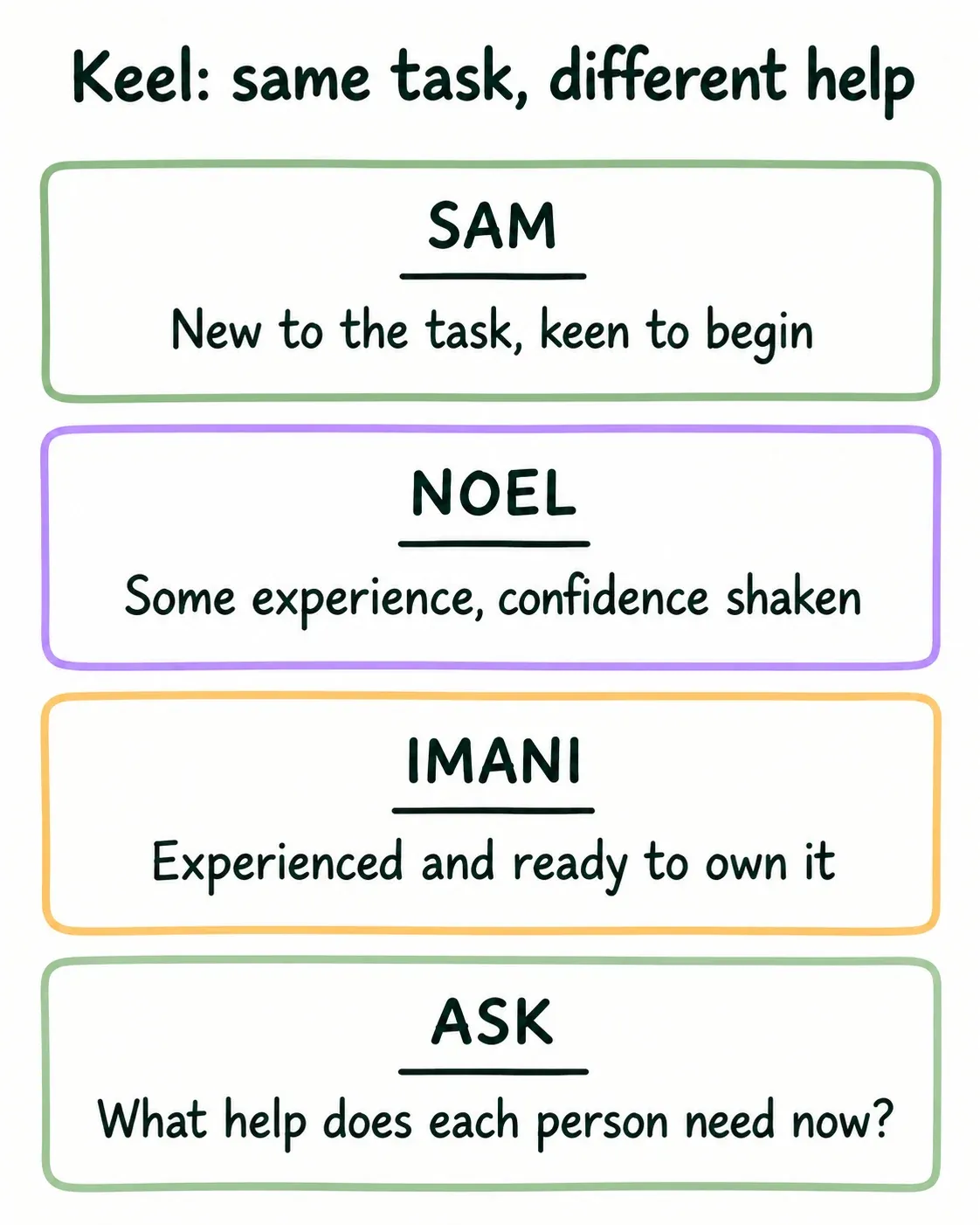
Priya is restarting an on-call rotation. Sam is keen but has never handled this task. Noel has some experience and little confidence after a blame-filled incident. Imani can already run the work independently. Giving all three the same instruction would be consistent. It would also ignore three different needs.
Priya manages the on-call rotation at the hypothetical Keel Systems. Sam, Noel, and Imani are fictional colleagues; their situations illustrate task conversations, not assessments of real people.
Situational leadership asks you to adjust direction and support to a person’s needs on a specific task. Someone may need close instruction in one area and considerable freedom in another. The task, experience, and current confidence matter more than your preferred style.
This guide uses the publicly described SLII structure associated with Blanchard: directing, coaching, supporting, and delegating. Earlier Hersey–Blanchard materials and later commercial versions use different terms and instruments. Do not mix their level labels as though they were identical systems.
Ask about this task, with this person, now
Priya begins with the work: responding to the rotation’s actual incidents, using its tools and escalation paths. Experience on another task does not settle readiness here. Neither does sounding confident in the planning meeting.
The three cards are provisional descriptions to discuss with each person. They are not fixed types. Priya needs work evidence, the colleague’s perspective, and a check for system problems before deciding how much direction or support to offer.
Match the style to the current need
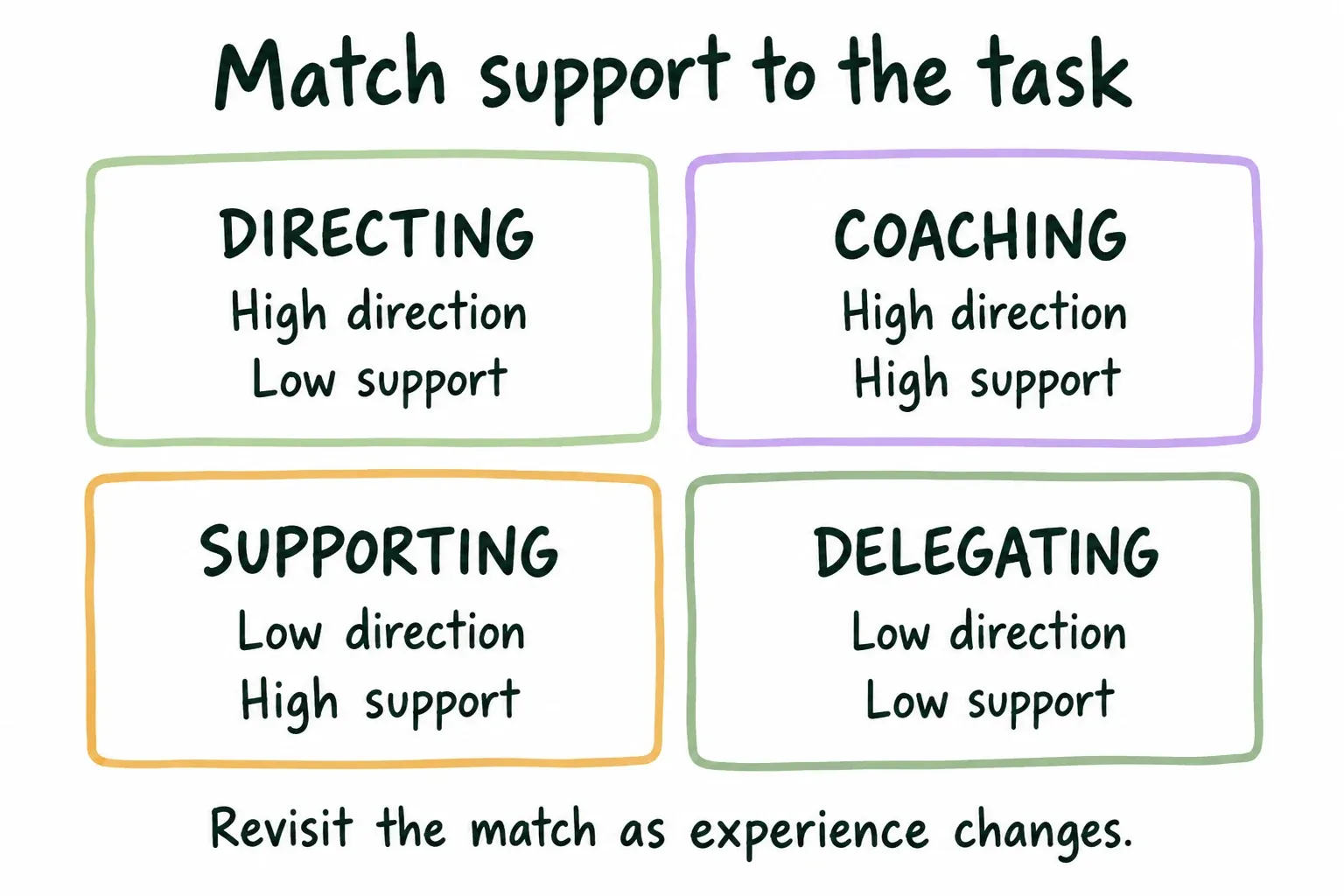
S1 · High direction, low support
Directing
For D1: low competence and high commitment on this task.
S2 · High direction, high support
Coaching
For D2: some competence, with low commitment on this task.
S3 · Low direction, high support
Supporting
For D3: competence is there, commitment is uneven.
S4 · Low direction, low support
Delegating
For D4: high competence and high commitment on this task.
Direction clarifies the goal, method, priorities, and checks. Support involves listening, encouragement, joint problem-solving, and help building confidence. They are separate dimensions: more of one does not automatically supply the other.
High direction is not permission to be disrespectful. Low support in the model does not mean indifference or unavailability. It means less emphasis on the particular supportive behaviors in this task relationship. Basic respect and a way to ask for help belong in every style.
Directing: show the method
Directing combines high direction with relatively low support in the model. It is associated with an enthusiastic beginner: someone motivated to start but without enough task-specific competence to choose a reliable method.
Sam is new to on-call work. He is keen, but he has never handled the pager. Priya explains the first alert checks, demonstrates the runbook, names escalation boundaries, and arranges a shared first week.
“Use your judgment” would give Sam responsibility without the information needed to exercise it. Asking what he thinks is useful, but it does not replace teaching the parts he has not learned yet.
Check understanding through practice. Someone nodding through a briefing has not necessarily learned the response sequence. The aim is to build competence, not to create permanent dependence on instructions.
Coaching: explain and work through the difficulty
Coaching combines high direction and high support. In SLII, it matches a disillusioned learner: some competence has developed, while commitment or confidence has dropped.
Noel has handled alerts, but a difficult incident review left him unsure about when to escalate. Priya still helps with the response method. She also discusses what happened, invites questions, and works through judgment calls with him.
Adding reassurance alone would leave the unclear decisions unresolved. Adding instructions alone might leave the fear of blame intact. The two needs can exist together.
Ask whether the work environment is creating the difficulty. If people are punished for sensible escalation, coaching them to feel more confident will not repair the incentive.
Supporting: let capability lead, help confidence catch up
Supporting combines low direction with high support. It fits the publicly described capable-but-cautious contributor: someone with useful competence whose confidence or commitment is variable.
Suppose Noel later demonstrates sound technical judgment but hesitates after the earlier review. Priya can ask him to propose the response, listen to his concerns, and help him test the decision. She need not prescribe every runbook step again.
That shift matters. Repeating instructions to someone who already knows the method can signal mistrust and conceal what the person actually needs.
Support still includes clear outcomes and boundaries. A listening conversation does not make the deadline, safety limit, or responsibility disappear.
Delegating: agree the result, give room on the method
Delegating combines low direction and low support in the model. It is associated with a self-reliant achiever: competence and commitment are both high for the task.
Imani has run the rotation successfully and wants ownership. Priya agrees the expected outcome, when she must be contacted, and the Monday review. Imani chooses the method.
Delegation is an agreement, not a disappearing act. The manager remains available for exceptional circumstances and accountable for the conditions in which the work happens.
Imani might still need directing on a new financial-planning task. Experience with the pager does not make someone an expert in everything. Labels should follow evidence about the work, not become badges attached to people.
Diagnose with the person, using evidence
Before choosing a style, establish the task and goal. “Become more senior” is too broad. “Lead the first response to these alert types within the agreed escalation rules” gives both people something to examine.
Ask what the person has done before, what they can demonstrate, and which parts remain uncertain. Separate skill from confidence. Someone may sound assured while missing a critical step; someone else may be cautious precisely because they understand the risk.
In SLII, competence concerns relevant knowledge and skills. Commitment includes motivation and confidence. Neither can be established reliably from a job title or one impression in a meeting.
Make your working interpretation visible: “You know this runbook, but the escalation decisions still seem uncertain. Would it help to work through the next two together?” That offers a hypothesis the person can correct, rather than announcing a permanent level.
Turn a style choice into a reviewable agreement
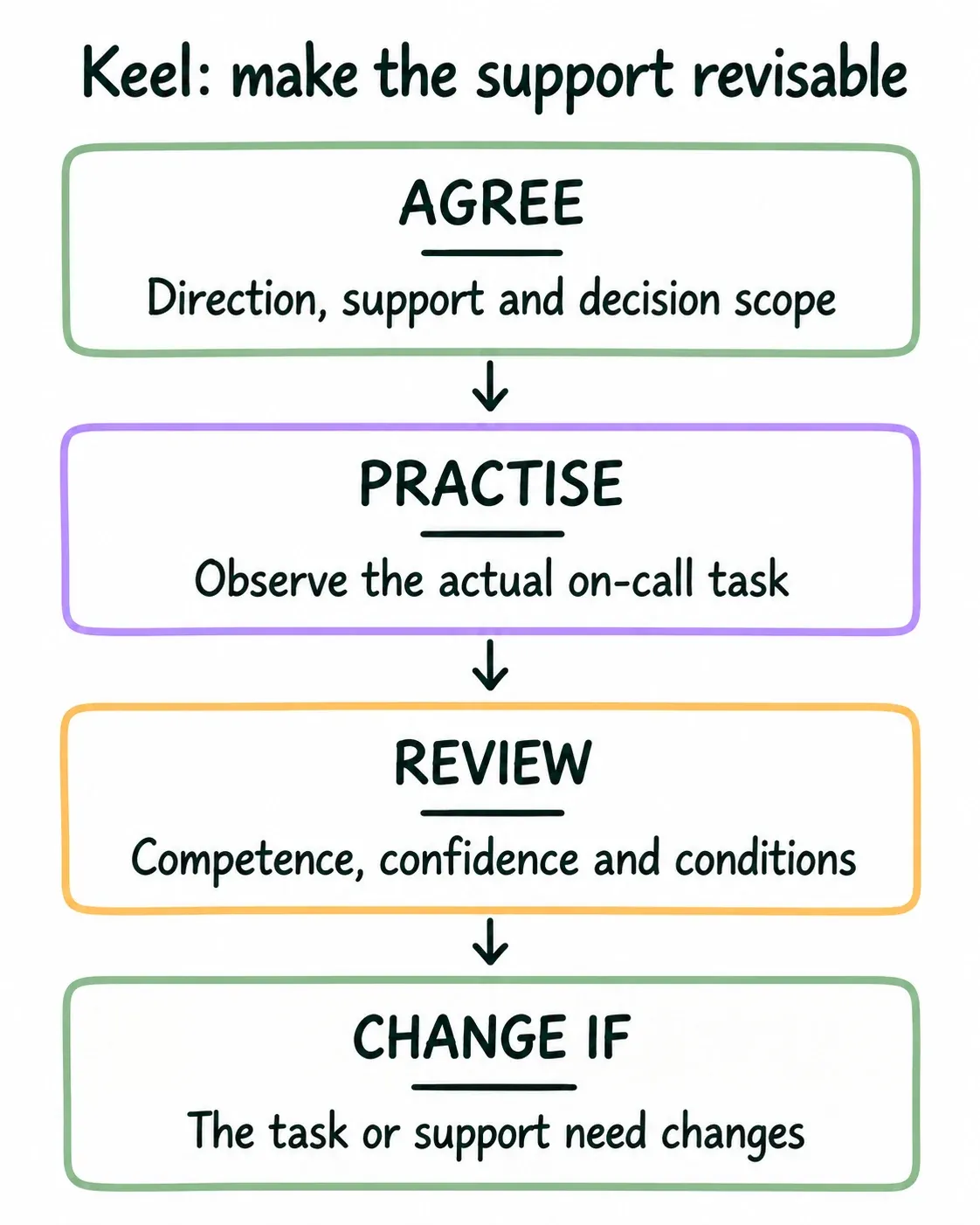
Priya agrees the task, demonstration or practice needed, decisions the colleague can make, and how to request help. She then reviews actual work with that colleague. This keeps “supporting” from becoming a warm conversation with no practical change.
A fresh task, an unexpected incident, or a change in confidence may call for a different agreement. If blame or overload is the main obstacle, Priya must address that condition too. A style adjustment cannot compensate for a working environment that makes learning unsafe or impossible.
Put the match into a working agreement
FrameworkWorld recommends a short conversation with six parts:
- Name the result and boundaries. Explain what good work means, what cannot be compromised, and when it will be reviewed.
- Check task-specific experience. Ask for recent examples or a practice demonstration. Identify what is known and what is new.
- Ask about confidence and motivation. Listen for concerns about workload, fairness, prior experiences, or unclear purpose.
- Agree direction and support. Say who chooses the method, which checkpoints matter, and how questions will be handled.
- Make the help available. A promise to coach needs time on the calendar and access to the relevant person or environment.
- Review after real work. Increase autonomy when the evidence supports it. Add help when the task changes or a gap appears.
For Sam, that could mean practicing the first three alert paths together and reviewing each early incident. For Imani, it could mean an agreed summary and escalation rule without daily instructions. The same team contains different working agreements because its members face different task needs.
Watch for the mistakes that make the model unhelpful
Turning a development level into an identity. “Noel is a D2” can become shorthand for low expectations. The model’s useful claim is task specificity. A level must be revisable, and a new task requires a fresh conversation.
Treating style as mood. Coaching is more than being friendly; directing is more than sounding firm. Ask what specific behavior you will change: demonstration, explanation, listening, practice, or authority over the method.
Confusing confidence with competence. Check work evidence. Managers can overrate people who communicate like them and underrate those who need more time to explain their thinking.
Coaching around a system problem. Understaffing, contradictory priorities, unclear ownership, or a blame culture may matter more than the style match. Fixing those conditions is management work too.
Treating the matching rule as a law. Evidence for rigid prescriptions is contested. Use the model as a practical question about help, then judge whether the working agreement is improving the actual task. A neat diagnosis does not guarantee a good result.
Commercial versions have their own trademarked materials and assessment instruments. This article is independent and does not reproduce a proprietary questionnaire or confer a certification.
When to use another framework alongside it
Use SMART Goals when the expected result is unclear. You cannot choose useful support for a goal neither person can describe.
Use RACI when several people disagree about who owns the work or decisions. Assigning responsibility and choosing the help required are related but separate tasks.
Jobs to Be Done offers a more limited companion question: what progress is someone seeking in this circumstance? It can prompt a discussion about motivation, but customer-research methods do not replace a task-specific management conversation.
For Priya, the practical result is three clear agreements she can revisit after the rotation starts. Her job is to notice when the help should change, rather than defend a single preferred management style.
Sources and further reading
- The Blanchard Companies describe the publicly visible SLII structure — goal setting, diagnosing, matching, and the four styles — in “A Situational Approach to Leadership”: blanchard.com/blog/a-situational-approach-to-effective-leadership.
- A companion overview of directive behavior, supportive behavior, and task-specific development is in “Four Reasons Why Flexing Your Leadership Style Builds Trust”: blanchard.com/blog/four-reasons-why-flexing-your-leadership-style-builds-trust.
- Paul Hersey and Ken Blanchard’s earlier joint work appears in editions of Management of Organizational Behavior. Naming differs from later SLII materials. This article does not reproduce proprietary questionnaires from either Hersey’s or Blanchard’s programs.
- SLII and Situational Leadership are trademarks of their owners. FrameworkWorld is not affiliated with those owners.