A good idea still needs a working business
A commuter needs a repair without losing a working day. Loop Workshop’s answer sounds excellent: collect the bicycle from home, lend a replacement, and charge a monthly subscription. Then someone asks who will drive across town and how many spare bicycles the workshop needs. The attractive promise has acquired an operating bill.
Loop Workshop is a hypothetical bicycle repair business considering a maintenance subscription for office workers. Its offers, costs, conversations, and proposed tests below are fictional.
The Business Model Canvas connects nine building blocks that describe how a business creates, delivers, and captures value. Associated with Alexander Osterwalder and Yves Pigneur, it brings customers, the offer, operations, and money onto one page. Strategyzer publishes the official tool.
Follow the promise before filling the canvas
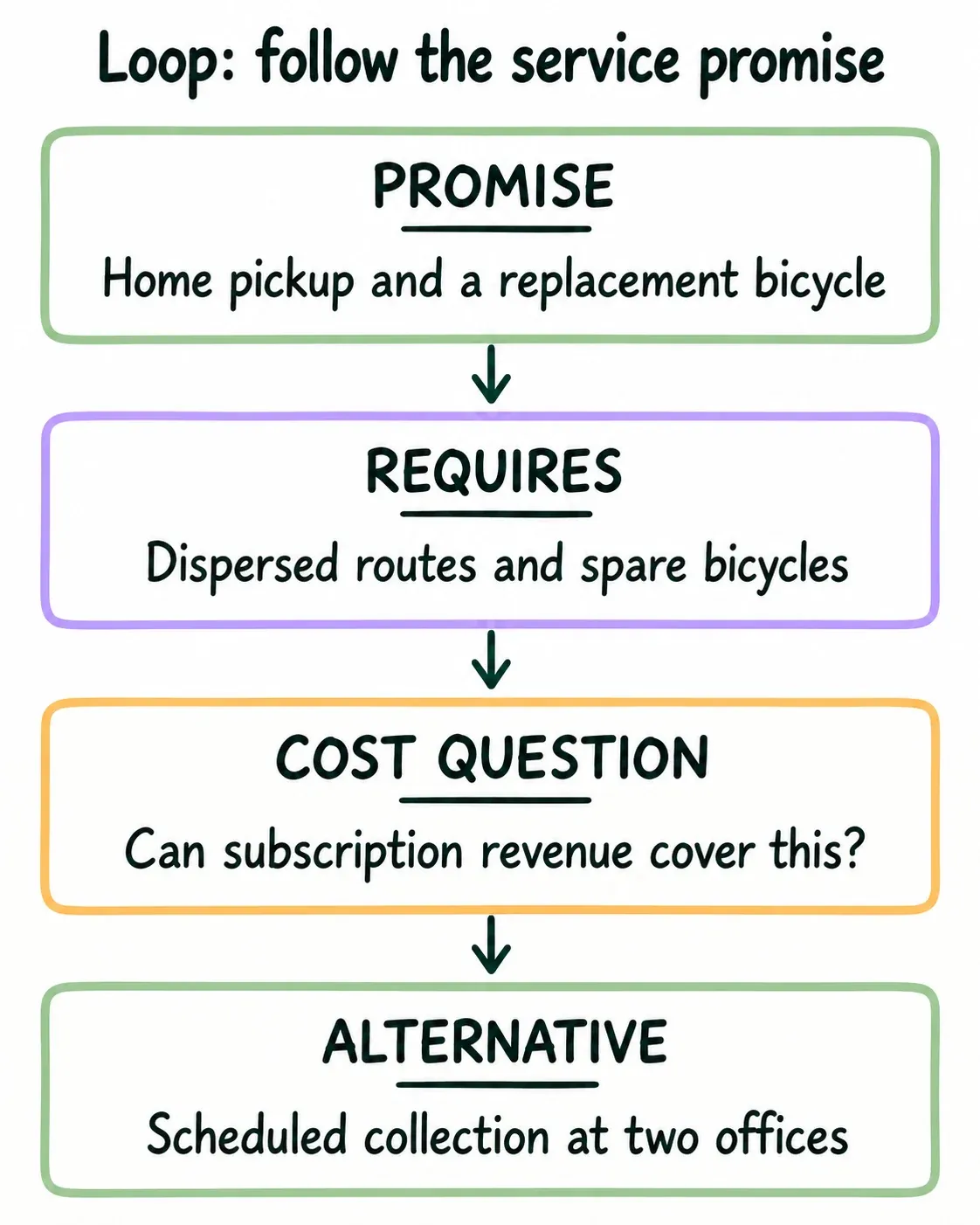
Loop first traces what would have to happen after a customer says yes. Home collection creates routing work. Replacement bicycles require stock, maintenance, and coordination. Those commitments connect the customer promise to activities, resources, and cost.
A second possibility is scheduled collection at two office buildings. It is less convenient for some customers, but potentially simpler to deliver. Keep it on a separate canvas: mixing the first offer’s convenience with the second offer’s costs would describe a business that does not exist.
What belongs in each block?
Key Partnerships
Outside capabilities the model depends on.
Key Activities
The work needed to keep the promise.
Key Resources
Essential people, assets, and knowledge.
Value Propositions
The useful offer for each customer group.
Customer Relationships
How customers are helped and retained.
Channels
How customers discover, buy, and receive.
Customer Segments
The groups you intend to serve.
Cost Structure
What delivery and operations cost.
Revenue Streams
Who pays, for what, and how.
Read from the value proposition toward the customer on the right, then examine what delivery requires on the left. The financial blocks sit underneath: costs must be supported by revenue. On a phone the same nine blocks become a labeled list. The position helps explain connections; it does not prescribe a workshop order.
Customer Segments
Who receives value? Identify distinct groups. A user and the person approving a purchase may belong to different groups.
Value Propositions
What makes the offer useful to those customers? State the problem solved or progress enabled, rather than a feature inventory.
Channels
How do customers discover, buy, and receive the offer? Selling through a reseller creates different obligations from selling directly.
Customer Relationships
What interaction do customers expect? Personal help, self-service, and an ongoing community require different work.
Revenue Streams
Who pays, for what, and how? Separate a subscription from a transaction fee. Revenue is not profit.
Key Resources
Which assets are necessary to deliver? Include skills, equipment, intellectual property, or access that the model depends on.
Key Activities
What must the organization do well? Name the work behind the promise, such as maintaining inventory or resolving support requests.
Key Partnerships
Which outside organizations supply essential capabilities? Write down what they provide and why they would participate.
Cost Structure
What does operating this model cost? Connect expenses to the resources, activities, relationships, and channels already named.
Put Loop’s office pilot into all nine blocks
This is a hypothetical draft, with important assumptions still open:
| Block | Office collection proposal |
|---|---|
| Customer segments | Workers at the two participating buildings |
| Value proposition | Maintenance with scheduled collection and turnaround |
| Channels | Agreed office visits and building communications |
| Customer relationships | Booking help and repair updates |
| Revenue streams | Proposed maintenance subscription; willingness to pay untested |
| Key resources | Repair skills, workshop capacity, and transport |
| Key activities | Collect, repair, coordinate, and return bicycles |
| Key partnerships | Building managers, subject to an actual access agreement |
| Cost structure | Repair labor, transport, coordination, and workshop costs |
A row being filled does not make it established. The access agreement and willingness to pay remain assumptions that could change several other blocks.
Follow one promise across the page
The connections reveal more than the individual boxes. Start with a promise to a specific customer, then ask what has to be true elsewhere for that promise to hold.
For Loop, collection from any address sounds convenient. It also creates route-planning work, transport costs, and a need to coordinate customer availability. If those requirements are absent from the left side and cost block, the canvas has found a gap worth discussing.
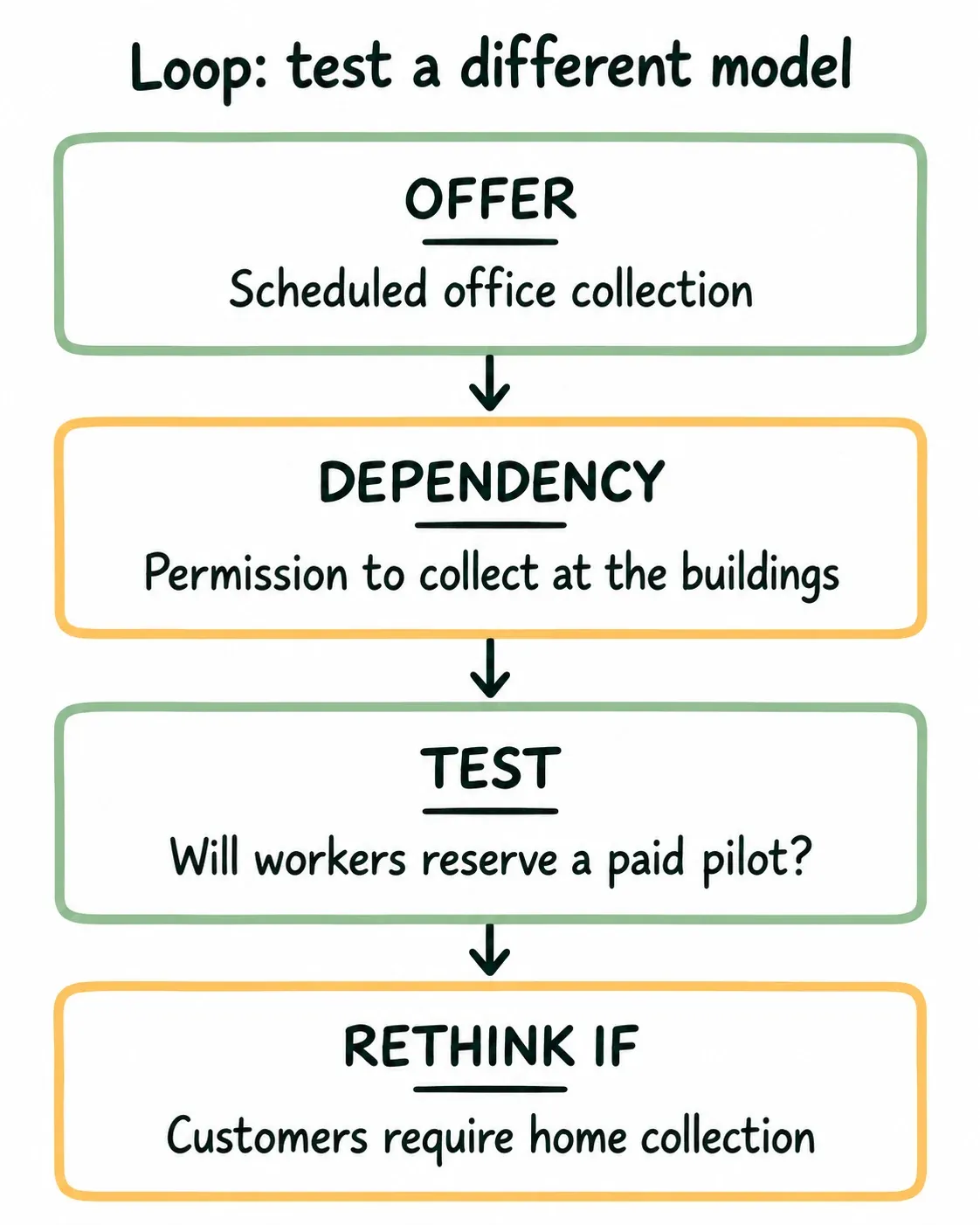
Scheduled collection from two office buildings changes several blocks at once. The channel narrows the reachable customer group. Building managers may become partners. Collection becomes easier to organize, but customers outside those buildings may no longer find the offer useful.
Track assumptions explicitly. A building manager’s verbal interest is different from an agreed collection arrangement. A worker saying the service sounds useful is different from reserving a paid pilot. Both statements belong on the page with their evidence status intact.
One practical technique is to draw a path through the relevant blocks as you narrate a customer’s experience. If you jump from purchase straight to revenue without naming delivery and support work, slow down. Somebody still has to do the repair.
Compare Loop’s two delivery models
Its first canvas promises collection from any address and a replacement bicycle during repairs. The customer segment looks plausible: commuters who cannot lose a working day to a repair. But mapping activities exposes two extra jobs: coordinating scattered pickups and maintaining replacement stock. Both require resources absent from the original cost estimate.
The team drafts a second canvas. It collects bicycles from two office buildings on scheduled days. Building managers become partners and a discovery channel. Replacement bicycles leave the initial offer; scheduled turnaround becomes the promise. The narrower channel changes both customer convenience and delivery cost.
Loop does not conclude that subscriptions will sell. It decides to test whether workers at those buildings will reserve a paid pilot. If they need home pickup to participate, the second model fails its central assumption. The canvas has improved the test by making the tradeoff visible.
Compare two models without blending them
| Decision | Home collection model | Office collection pilot |
|---|---|---|
| Customer access | Any eligible address | Workers at two buildings |
| Service promise | Pickup plus replacement bicycle | Scheduled collection and turnaround |
| Essential work | Dispersed routing and replacement-stock management | Agreed building visits and repair scheduling |
| Assumption to test | Convenience supports the extra cost | Enough workers accept the narrower arrangement |
Both columns describe hypothetical proposals, not established results. Keeping them separate prevents the team from borrowing the convenience of the first and the operating costs of the second to create an imaginary best-of-both model.
Choose the test by asking which uncertain statement could make the model fail. If office access is unresolved, secure an actual collection arrangement before treating the channel as available. If workers will not reserve a paid slot, better route planning alone will not establish demand.
A useful test has a named audience, a realistic offer, and a result that changes the decision. Loop can state the service boundary, ask for a genuine reservation, and record objections. An enthusiastic internal vote is not the same evidence.
After the pilot, update the connected blocks together. Suppose workers value evening collection more than a subscription. That may change the offer, staffing, revenue arrangement, and pickup channel. Revising only the headline would leave the canvas describing yesterday’s model.
Keep the old version with its date and learning notes. Seeing which assumptions changed helps the next review start from evidence instead of reopening every conversation.
Choose the assumption that could break the model
Loop’s next move is to seek an agreed office collection arrangement and offer workers a clearly bounded paid pilot. A genuine reservation would answer a different question from “does this sound useful?” Neither removes the need to inspect delivery costs.
If workers require home pickup, the office model needs revision. If building access is unavailable, that channel is still an assumption. The canvas has earned its place by making those possible failures visible before the workshop commits to replacement stock.
How to build a useful canvas
The following is FrameworkWorld’s suggested working method, not a replacement for Strategyzer’s official instructions.
- Choose one offer, customer group, and decision. Write the date and whether the canvas describes today’s business or a proposed version.
- Draft the customer and value blocks together. If the offer serves several groups, mark which promise belongs to which group.
- Trace one customer’s route from discovery to delivery and support. Add the channels and relationships that route needs.
- Work backward into activities, resources, and partners. Challenge anything the team assumes will happen for free.
- Describe payment and major expenses. Use rough amounts only when you can explain their basis; mark unknowns openly.
- Label each important statement as observed or assumed. Attach evidence to observed claims.
- Pick the assumption most likely to invalidate the model. Design a small test with a result that would make you revise or stop.
Stop polishing the canvas once the next test is clear. A tidy page can hide an untested willingness to pay.
When to use it—and where it falls short
Use the canvas to compare business models, examine a proposed channel, or prepare a discussion between product and operations. It is less useful as a detailed delivery schedule or a cash-flow forecast.
The biggest mistake is mixing facts with aspirations. A partner’s logo does not establish a partnership. A named revenue stream does not establish demand. Record the status of each claim.
The canvas also compresses time. It does not show whether cash arrives before supplier bills become due. Build a separate financial forecast before committing money. Nor does it explain whether competitors can copy the model or suppliers can capture its returns.
Alternatives and related frameworks
SWOT Analysis scans the situation around a strategic decision. Use it when the first question is what helps or threatens the business; use the canvas when the question is how its parts fit together.
Porter’s Five Forces examines industry pressures that the canvas leaves largely outside the page. A coherent model can still face powerful buyers or cheap substitutes.
Jobs to Be Done investigates customer progress. Use it before accepting a value proposition that comes only from an internal brainstorming session.
Sources and further reading
- Strategyzer, The Business Model Canvas, official tool page, accessed October 21, 2026. Use this page for the original template and its current terms.
- Strategyzer, Business models: the toolkit to design a disruptive company, April 24, 2024. Defines the nine building blocks.
FrameworkWorld is an independent publication and is not affiliated with Strategyzer. The diagram above is an original explanatory rendering, not an official template.