Why does the page sound good but go nowhere?
Lowell’s workshop page promises to “transform your engineering culture.” An engineering manager scrolling between incidents has seen that sort of sentence before. The page lists features and offers three equally prominent buttons. Before polishing the adjectives, Lowell needs to make the reader’s next step make sense.
Lowell & Co. is a hypothetical studio offering engineering managers a one-day incident-review workshop. The offer, audience scenario, copy, and proposed tests are invented.
AIDA reviews a message through four reader states: attention, interest, desire, and action. It helps you spot a missing connection between noticing an offer and doing something about it.
Start with the questions the page must answer
The page concerns a specific frustration: incident reviews produce actions that stall. Lowell can begin there, explain the gap, show what participants will practise, and offer dates and a syllabus. Each part earns the next part a little more attention.
The worked sequence below is a draft to inspect, not a proven campaign. AIDA helps Lowell connect the message. It does not establish that the workshop is valuable, that the audience trusts the studio, or that every buyer will read in this order.
Attention: give the right reader a reason to stop
The sequence asks: will the right person notice, keep reading, want the outcome, and understand what to do next? Those questions connect. A larger button cannot rescue an offer the reader never found relevant.
Attention is being noticed by someone who could benefit from the offer. A surprising headline can attract people who will never need what follows. That may produce traffic without a useful conversation.
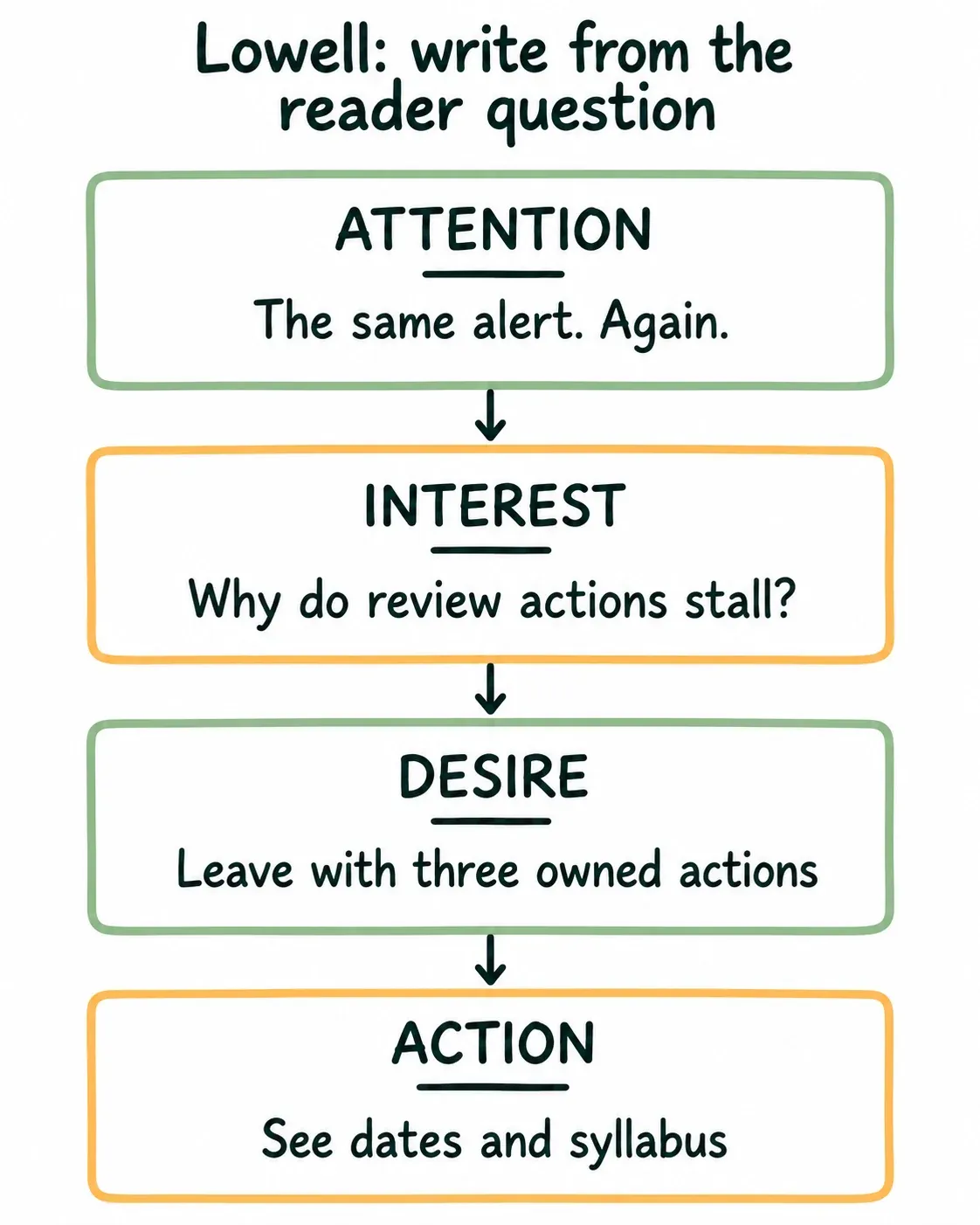
Lowell’s first headline is “Transform your engineering culture.” It could appear on almost any training page. A more specific opening is: “The same alert. Again.” A manager dealing with repeated incidents has a reason to read on.
Specificity should come from a real customer situation, not from inventing a fear. If the offer concerns incident reviews, the page should establish that promptly. A clever hook that hides the subject makes the reader solve an unnecessary puzzle.
Check where the message will appear. An email subject, page heading, and sales-call opening have different space and context. The same customer problem can inform all three without using identical wording.
Interest: connect the problem to a useful explanation
Once readers notice, help them understand why the message matters to their situation. Interest comes from relevance and useful detail, rather than a second, louder headline.
Lowell can describe a recognizable gap: reviews identify causes, but follow-up work leaves the room without a clear owner, date, or check. A manager can compare that explanation with their own experience.
Then explain what the workshop actually covers. Who is it for? What work will participants bring? Which part of the process will they practice? A short sample or outline can support interest more effectively than a paragraph about being passionate about excellence.
Do not assume that naming the pain proves you can solve it. The reader still needs enough information to judge whether your approach fits. Keep claims proportionate to evidence you can actually show.
Desire: make the outcome concrete and credible
Interest means “this is relevant.” Desire adds “I would value that result enough to consider the next step.” The difference is easier to see in an outcome than in an adjective.
For Lowell: “Leave with three owned actions from one open incident review.” That is more tangible than “unlock team potential.” It gives the reader something to examine, and it gives the studio a promise it must be able to deliver.
Distinguish an output the workshop can provide from a business result it cannot guarantee. Helping participants draft clear actions does not prove those actions will prevent every future incident. The page should not quietly stretch one claim into the other.
Useful proof might include a sample exercise, a real syllabus, or a permitted customer account with its original context. Invented testimonials, unsupported outcomes, and artificial urgency weaken the offer even if they make the copy sound more persuasive.
Action: ask for a step the reader is ready to take
A reader should be able to tell what happens after the main action. “See workshop dates” is a reasonable next step for someone still checking availability. “Pay now” requires more confidence and more information.
Lowell’s original page asks visitors to contact the studio, download a guide, and follow its updates with equal emphasis. The revised page gives one main action: see workshop dates and the syllabus. Supporting links can remain where useful, but they should not compete with the purpose of the page.
Place important conditions near the action: price, time commitment, audience, and what follows. Surprise requirements after a click create friction that button wording cannot fix.
A clear action can also be a smaller commitment. In a complex purchase, sharing a buying guide with a budget owner may be more appropriate than requesting an immediate order. Match the ask to what this reader can actually authorize.
Watch the workshop message take shape
The revised message has a visible chain. The recurring alert earns attention. An explanation of stalled actions creates interest. A concrete workshop output gives the reader something to want. A date-and-syllabus link makes the next step understandable.
Now test the chain against the audience. Suppose managers are really trying to satisfy an audit, while the studio has assumed their main concern is repeated alerts. The copy can be coherent and still miss the job. That is a discovery problem worth investigating before another round of headline edits.
Or suppose managers want the workshop, but the next available date conflicts with their planning cycle. The action may be clear and the offer still unsuitable. AIDA helps inspect communication; it cannot remove every obstacle to purchase.
Find the reason for hesitation before changing the copy
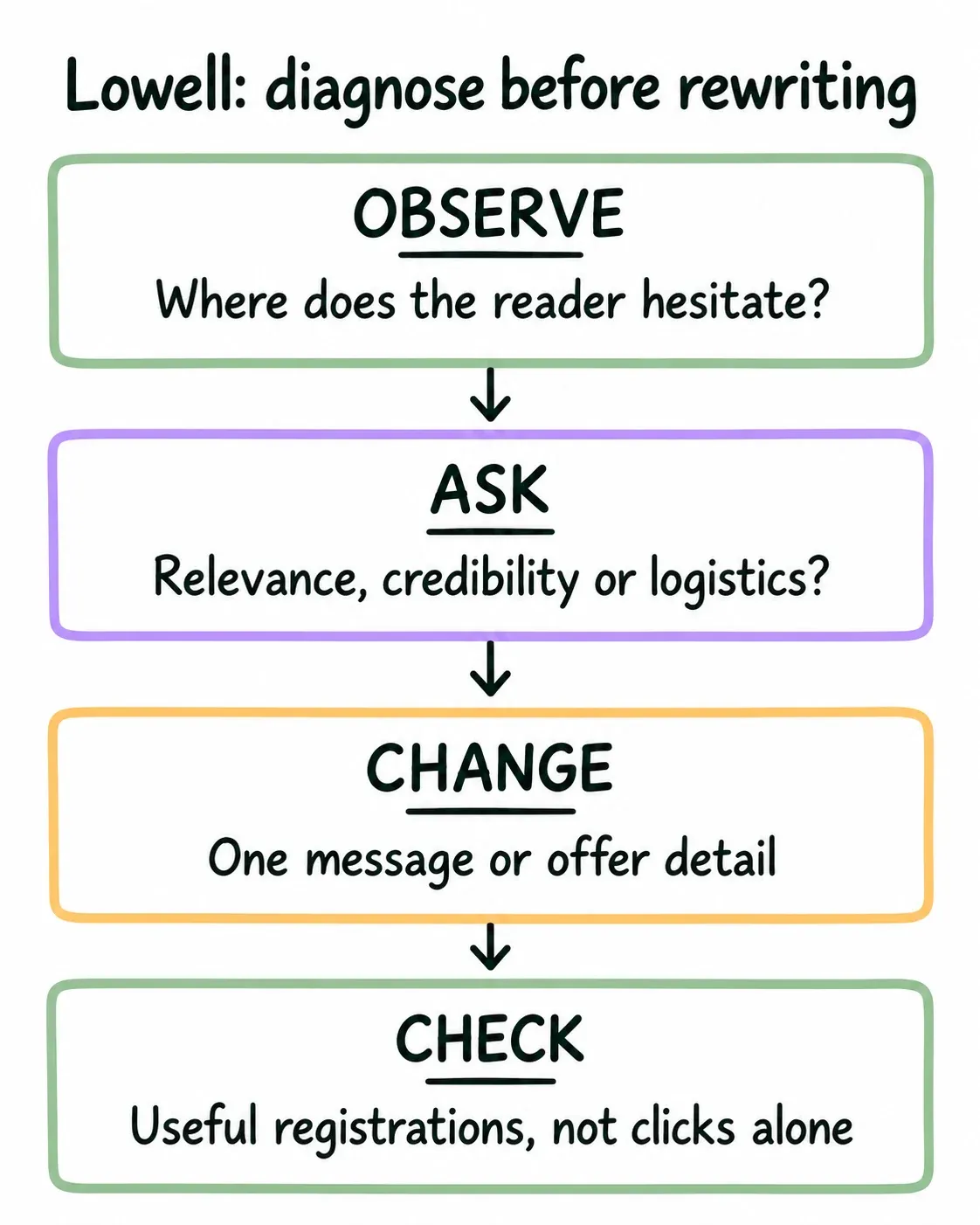
If suitable readers leave, Lowell needs more than a click count to understand why. A reader may find the problem irrelevant, doubt the promised exercise, lack permission to book, or be unable to attend the available dates. Those call for different responses.
The team can ask readers to explain the offer and expected next step, then test a focused revision. It should review useful registrations and the resulting experience as well as clicks. A busier button does not establish that the message attracted the right participants.
Use AIDA to review a draft
FrameworkWorld recommends reviewing the reader’s experience before editing individual sentences.
- Choose one reader and one next action. Be specific about what they already know and what decision this message should support.
- Underline the attention cue. Ask whether it names something relevant or merely makes noise.
- Mark the useful explanation. Show where interest becomes stronger because the reader learns how the offer relates to their situation.
- Circle the concrete outcome and evidence. Challenge promises that depend on results you cannot establish.
- Find the primary action. Explain what happens after it and whether the surrounding information supports that commitment.
- Remove a stage mentally. If deleting the interest section changes nothing, it may be repeating the headline. If the ask is missing, the draft is unfinished.
- Test comprehension with appropriate readers. Ask what they think the offer does, who it is for, and what they would do next. Polite approval is less informative than an accurate explanation.
After publishing, investigate the point where people stop. A form that is too long needs a different fix from an unclear offer. Use evidence from the actual journey before deciding that attention is always the problem.
Keep the model in proportion
People do not always read in order. They skim, return, compare tabs, and ask colleagues. Give the page a useful sequence without insisting that every reader must experience four neat mental stages.
Buying groups contain different roles. The person interested in a workshop may need a manager to approve the budget. One message may need to support a conversation rather than close the entire sale.
A persuasive message can lead to a disappointing experience. Check delivery, refunds, and customer outcomes as well as clicks. AIDA says little about whether the product keeps its promise.
Pressure is not a required ingredient. You can earn attention and describe value without invented scarcity or exaggerated claims. Truthful boundaries can help a suitable buyer decide.
The four-stage sequence is widely associated with E. St. Elmo Lewis and early advertising teaching, but popular origin accounts differ. This guide does not assign a tidy founding date or reproduce an unverified quotation.
Pair the message with the right investigation
Use Jobs to Be Done when you do not understand the progress the reader wants. It supplies the customer context a message needs.
Use Marketing Mix to check whether the product, price, and access support the promise. Use Sales Funnel to measure observable progression and locate an obstacle worth investigating. AIDA’s mental states are not automatically measurable funnel events.
For Lowell, the next useful draft makes a specific offer understandable and gives a suitable manager one clear way to learn more. That is a result the team can review without arguing endlessly about whether the copy feels exciting enough.
Sources and further reading
- The four-stage sequence is widely associated with E. St. Elmo Lewis and with early sales and advertising teaching. This article does not cite a specific “founding” document because popular versions of that origin disagree.
- Edward K. Strong Jr., The Psychology of Selling and Advertising (1925), is a standard later book in this teaching tradition. No public-domain link is offered here.
- For the customer progress a message should describe, see Clayton M. Christensen, Taddy Hall, Karen Dillon, and David S. Duncan, “Know Your Customers’ ‘Jobs to Be Done,’” Harvard Business Review, 2016: hbr.org/2016/09/know-your-customers-jobs-to-be-done.