A buyer profile needs more than a name and a hobby
Fern’s demo is going well. The coordinator wants to see how a last-minute schedule change reaches the field team. The owner asks what the subscription replaces and how much setup requires. A single profile called “busy business customer” is giving the sales team almost no help with either conversation.
Fern Scheduling is a hypothetical provider of field-visit scheduling software. All interviews and buying patterns in this walkthrough are invented. In real personas, the composite is fictional but the recurring patterns must come from research.
A buyer persona is a fictional composite grounded in evidence about recurring buying needs and behavior. HubSpot’s practitioner guidance uses research-based profiles to help teams understand customers. The person is fictional; the underlying patterns should not be.
Map the buying situation before inventing a biography
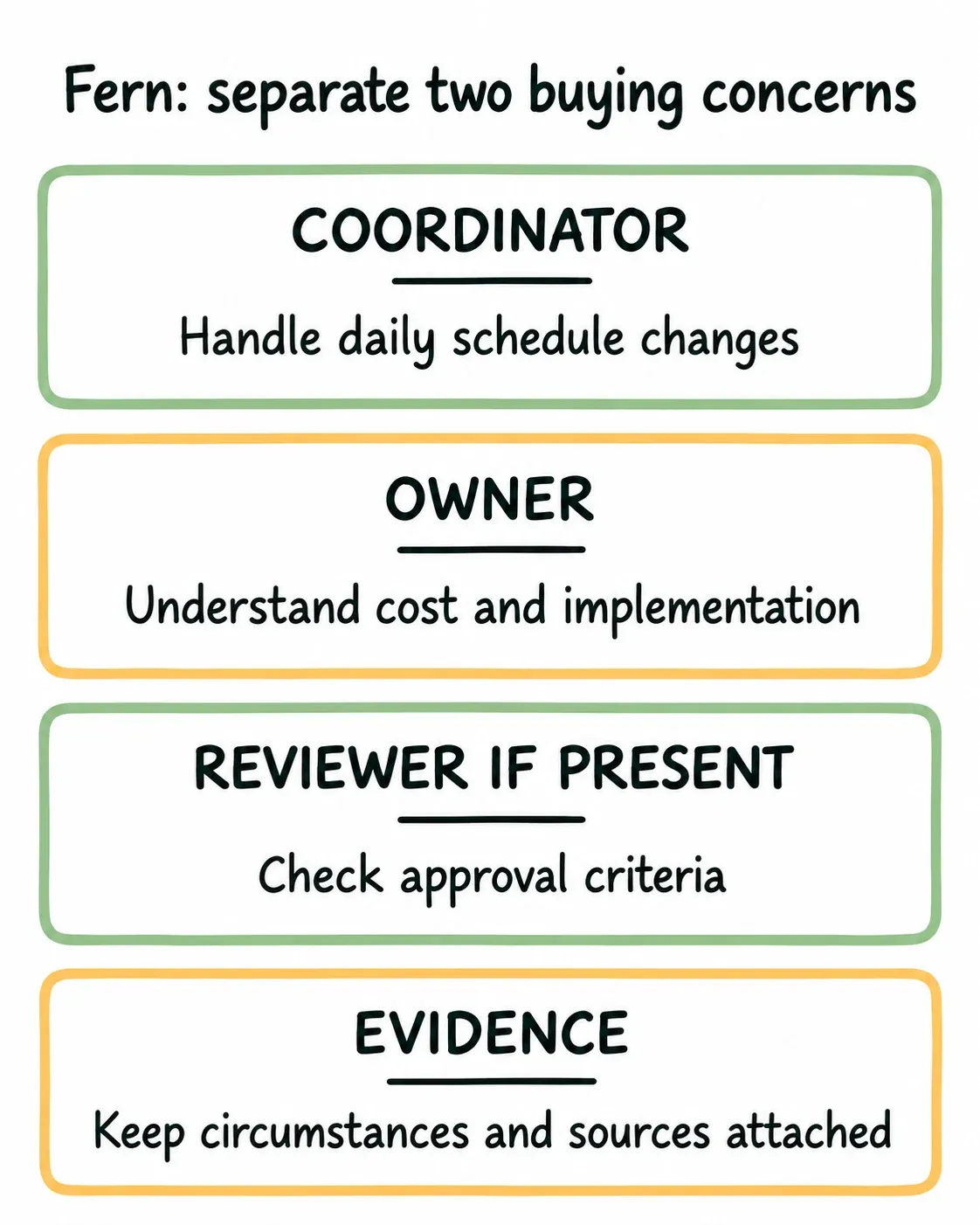
Fern separates the work of using, approving, and reviewing a purchase. A coordinator’s daily workflow and an owner’s implementation concern may appear in the same buying group. They need different evidence, not different stock photos and hobbies.
The map gives the team questions to research. It should discover additional reviewers where present, record contradictions, and keep circumstances attached to each pattern. A role is a starting point for inquiry, not permission to decide what a person must think.
Start with buying behavior
FrameworkWorld’s suggested working profile records buying situation, desired result, decision process, and evidence needed. Its fields are a starting point, not a universal persona standard. Every material statement should be traceable to research or labeled as an assumption.
An audience segment identifies a group. A persona explains patterns within a group well enough to guide a decision. Job title can help recruit interviewees, but it does not establish that they share the same problem or purchasing authority.
Keep the buyer separate from the user where their concerns differ. A team member may use the product daily while a department lead approves the budget and a security reviewer can block adoption. Combining those roles into a single fictional person hides the buying process.
FrameworkWorld recommends keeping the working profile short. Include the trigger for looking, the outcome sought, the alternatives considered, the people involved, and the concerns that must be resolved. Add demographic details only when evidence shows they matter for the decision at hand.
Keep the profile close to a real decision
Suppose Fern wants to improve its buying guide. It needs to understand the questions that stop an organization from deciding, who asks them, and what evidence helps. It does not need a detailed account of an invented customer’s weekend.
Start with recent buying episodes. Ask what triggered the search, which alternatives were considered, how the purchase involved other people, and what nearly stopped it. Include declined or delayed purchases where possible; a profile based only on satisfied customers can miss the hardest objections.
Look for patterns across accounts without erasing differences within them. Two office coordinators may share a daily scheduling problem while working under very different purchasing rules. Treat that difference as evidence about the process, not noise to remove from the persona.
Trace important statements back to research. “Needs an implementation checklist” should have a basis in repeated questions or a specific hypothesis to test. A profile can remain provisional while the evidence is thin.
Give the persona a date and a purpose. A profile built to explain an early self-service purchase may become less useful when the company moves toward larger accounts with formal procurement. Revisit the buying behavior instead of simply changing the fictional person’s job title.
Choose different evidence for Fern’s buying concerns
The team initially groups everyone under busy business owners. In the imagined interviews, office coordinators focus on correcting last-minute schedule changes. Owners focus on whether a subscription will create another recurring cost without replacing existing work.
Instead of adding different hobbies to two profiles, the team separates decision roles. The coordinator needs to demonstrate a workable daily handoff. The owner needs to understand cost, rollout effort, and what would happen if the team stopped using the service.
Marketing creates a demonstration of the change workflow and a clear buying guide covering pricing and implementation. Sales checks which person is involved before choosing the next conversation. It does not assume the coordinator lacks influence or that every owner has the same objection.
The personas have earned their place only if those distinctions help real conversations. If new research contradicts them, the profiles change rather than forcing prospects into the old labels.
Different roles need different evidence
| Role in Fern’s hypothetical purchase | Concern to investigate | Useful sales material to test |
|---|---|---|
| Office coordinator | Handling last-minute schedule changes | Demonstration of a real change workflow |
| Business owner | Cost and whether existing work disappears | Pricing and rollout guide with clear conditions |
| Other reviewer, if present | Requirements that could block adoption | Answers tied to that reviewer’s actual criteria |
These are invented research patterns, not claims about every coordinator or owner. The third row is a reminder to discover additional decision roles rather than assume all purchases contain the same committee.
The coordinator may be the strongest advocate and have substantial influence. The owner may understand the operational problem in detail. A role distinction should help ask better questions, not assign people fixed personalities or levels of importance.
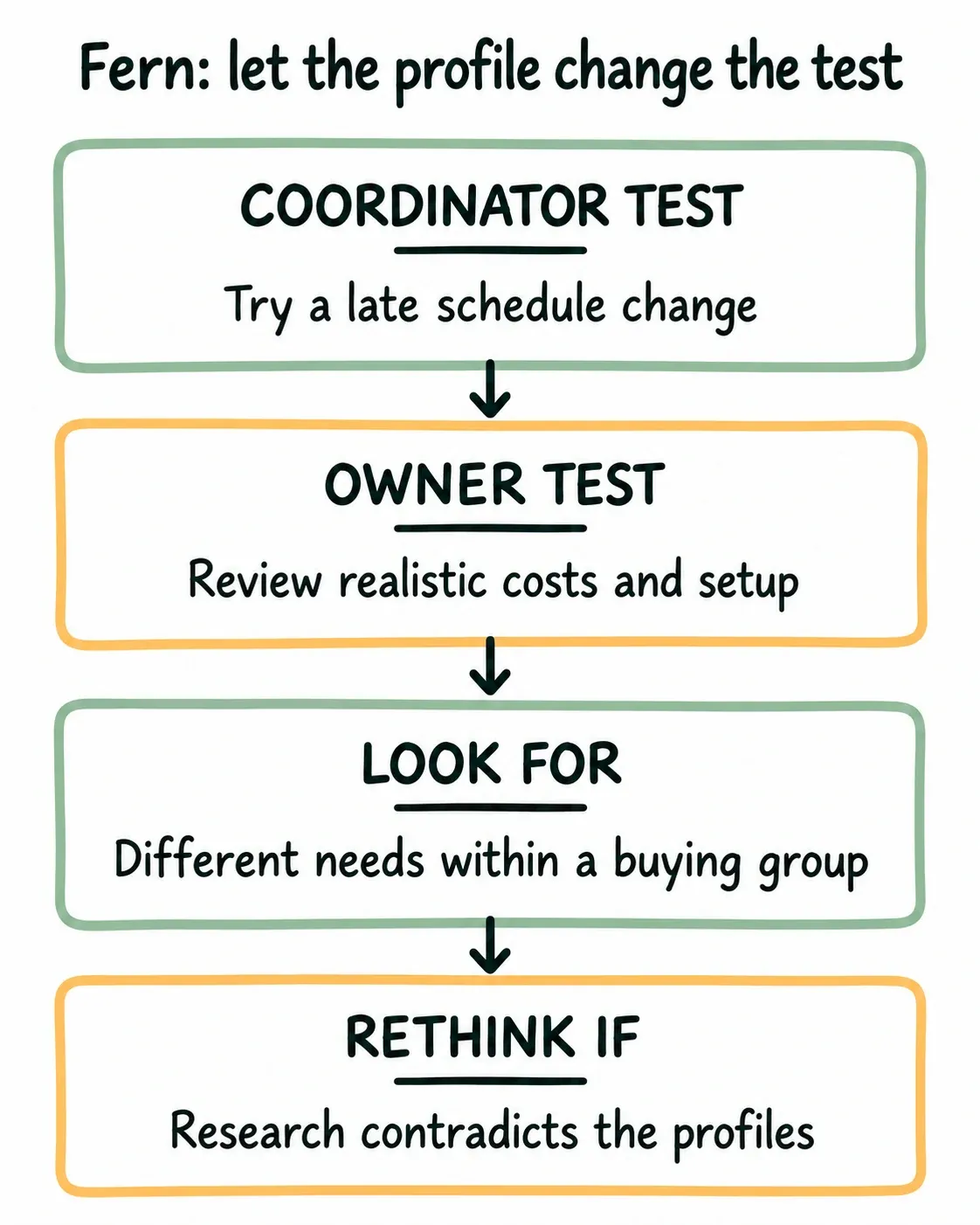
Fern tests whether the materials help an actual buying conversation. Can a coordinator demonstrate the handoff? Can an owner explain the costs and implementation effort? Which unanswered question remains? A profile becomes useful through the decisions it improves.
If the new material is understood but buying still stalls, investigate the reason. Timing, an unavailable budget, a missing capability, or a better alternative may matter more than messaging. Personas organize customer understanding; they do not guarantee a sale.
Keep counterexamples in the research notes. If some organizations buy mainly to improve auditability rather than daily coordination, the team may need another profile or a different way to segment the audience. Forcing every account into the original composite would make the tool less accurate precisely when the market is teaching you something new.
Test whether the profiles improve a real conversation
Fern prepares a schedule-change demonstration and a realistic cost-and-rollout guide. It checks whether each helps the relevant person answer an actual buying question. Sales first establishes who is involved rather than selecting a script from a job title alone.
If research contradicts the profiles, change the profiles. If prospects understand the material but cannot buy because a capability is missing, more persona detail will not fix the product. The useful output is better decisions about evidence and communication, not a convincing fictional biography.
Research and build the profile
- Name the marketing or sales decision the persona should improve. This bounds the research questions.
- Review available customer records and recruit a range of relevant participants. Include people who declined or delayed a purchase where you can reach them, rather than hearing only from advocates.
- Ask about a recent buying episode. Reconstruct what happened, who became involved, which alternatives were considered, and what evidence changed the decision.
- Look for recurring patterns and meaningful differences. Do not turn one forceful interview into a whole segment.
- Draft a composite with references to the underlying research, uncertainty labels, and a date. Protect participant privacy in anything shared beyond the research team.
- Ask marketing, sales, and customer support to challenge it using concrete evidence. Record unresolved disagreements as research questions.
- Apply the profile to one message or sales artifact and review the result. Retire details that do not help the decision, and revisit the profile when buying behavior changes.
Do not treat this process as a fixed interview quota. The evidence required depends on the diversity of the audience and the importance of the decision. If findings are thin, publish a provisional internal hypothesis rather than calling the persona validated.
Limits and alternatives
Personas can harden stereotypes, conceal disagreement within a group, or make a biased customer sample appear representative. Keep differences and uncertainty visible. Qualitative findings do not establish how large a segment is or its expected revenue.
Generated profiles cannot establish facts about customers without research. If you use software to organize notes, review each proposed pattern against the source and preserve counterexamples.
Use market sizing or quantitative segmentation when you need to estimate group size. Use an account-level buying map when a particular sale depends on several named roles. A composite persona is too general to replace either exercise.
Related frameworks
Empathy Mapping organizes what people say, think, do, and feel in a situation. Use it to examine underlying research before compressing patterns into a persona.
Unique Selling Proposition turns a customer-relevant difference into a reason to choose an offer. Use the persona’s buying concerns to test whether that reason actually matters to the intended audience.
Sources and further reading
- HubSpot, Buyer Personas, accessed October 21, 2026. Practitioner guidance on research-based persona development. The working profile, research sequence, and fictional buying example here are FrameworkWorld’s recommendations.