Why would this customer choose your offer?
A shift worker needs to hand over a bicycle before work. Harbor Cycle’s page says “excellent quality and friendly service.” That sounds pleasant, but it does not answer the practical question. Several other shops can be pleasant too. Why should this customer choose this one?
Harbor Cycle is a hypothetical bicycle repair service. Customer concerns, operating details, draft claims, and proposed tests below are invented.
A unique selling proposition, or USP, expresses a customer-relevant reason to choose your offer over alternatives. BDC describes it as a short statement of a meaningful difference. You may also see unique selling point.
Compare the offer with the customer’s actual alternative
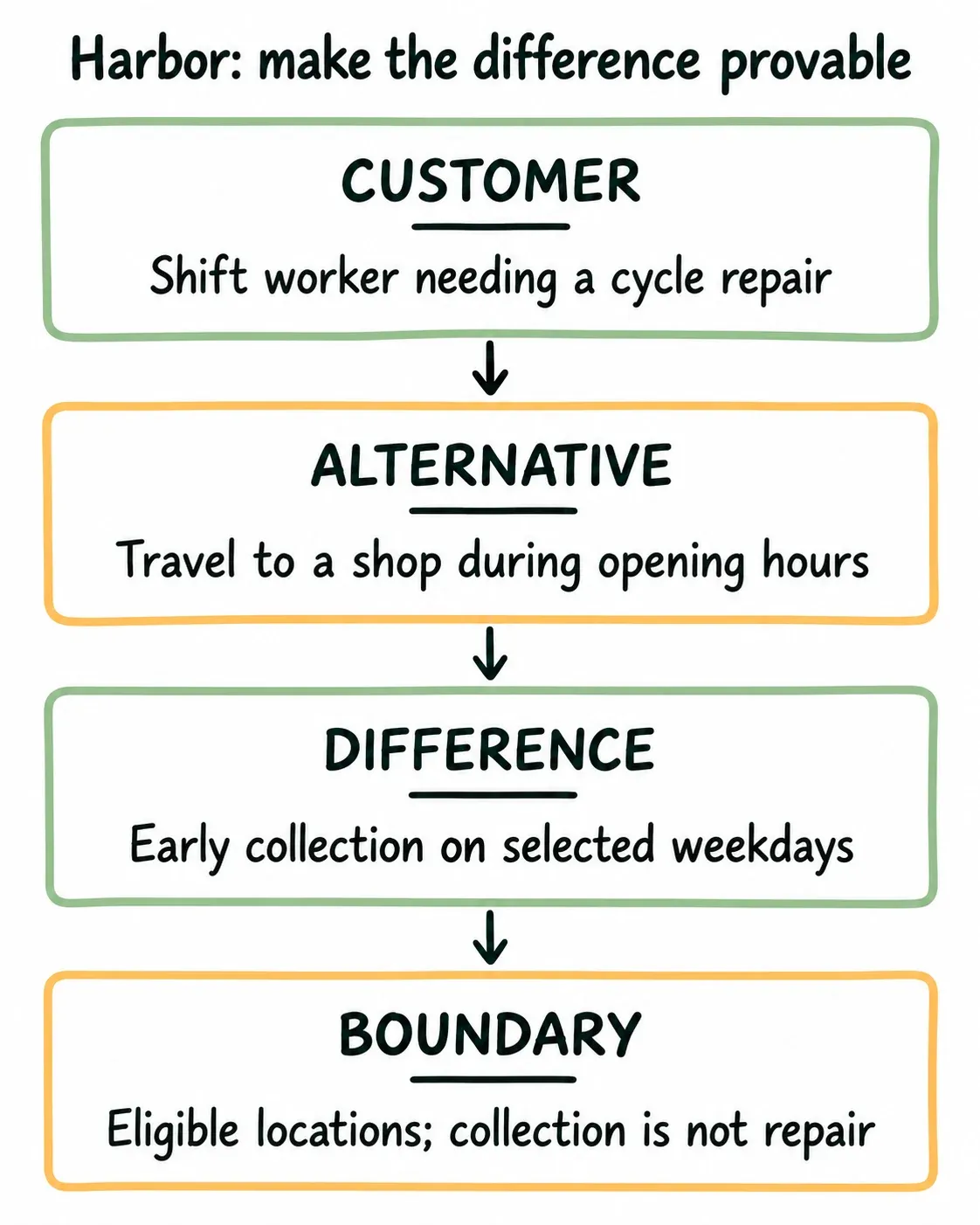
Harbor considers bookable early collection slots on selected weekdays and in eligible locations. The benefit is a repair handoff that fits around a shift. The difference is a particular collection arrangement the shop can make available.
That is narrower than “convenient repairs,” and easier to check. It also has a boundary: early collection does not guarantee same-day completion. The map keeps the customer’s alternative and the service conditions visible before the team writes a stronger sentence.
Benefit, difference, and proof
FrameworkWorld uses this three-part drafting aid: customer benefit, meaningful difference, and supporting evidence. It is an editorial way to test a proposition, not a separate historical model or a formula for guaranteed sales.
The audience and its alternatives anchor all three parts. The same capability can be decisive for one buyer and irrelevant to another.
A benefit describes what improves for the customer. “Exports to a spreadsheet” is a capability. “Review exceptions in your existing reporting workflow” explains a possible use. Check that customers actually value that use before promoting it.
A difference compares the offer with a real alternative, including doing nothing or handling the task internally. “Easy to use” is too broad to help a buyer compare. Name the particular effort removed or constraint addressed.
Proof supports the claim at the level at which you make it. A demonstration can show how a workflow operates. It does not establish that every customer will save a specified amount of time. Avoid turning an isolated customer outcome into a universal promise.
These checks can reveal that the problem belongs in product or operations. If the offer cannot deliver a meaningful difference, better wording will not create one.
Compare against the customer’s actual alternative
A proposition makes more sense when the alternative is explicit. For a shift worker, that alternative might be another shop, a repair at home, borrowing a bicycle, or postponing the work. Each creates a different comparison.
Ask what inconvenience the customer is trying to avoid. Early collection may matter because daytime appointments conflict with work. It might matter less to someone who mainly wants certainty about when the bicycle will return.
Then connect the proposed benefit to a specific operating capability. If Harbor offers early slots only on selected weekdays and in eligible locations, those boundaries belong beside the promise. An unqualified claim of convenience would hide the conditions that make it true.
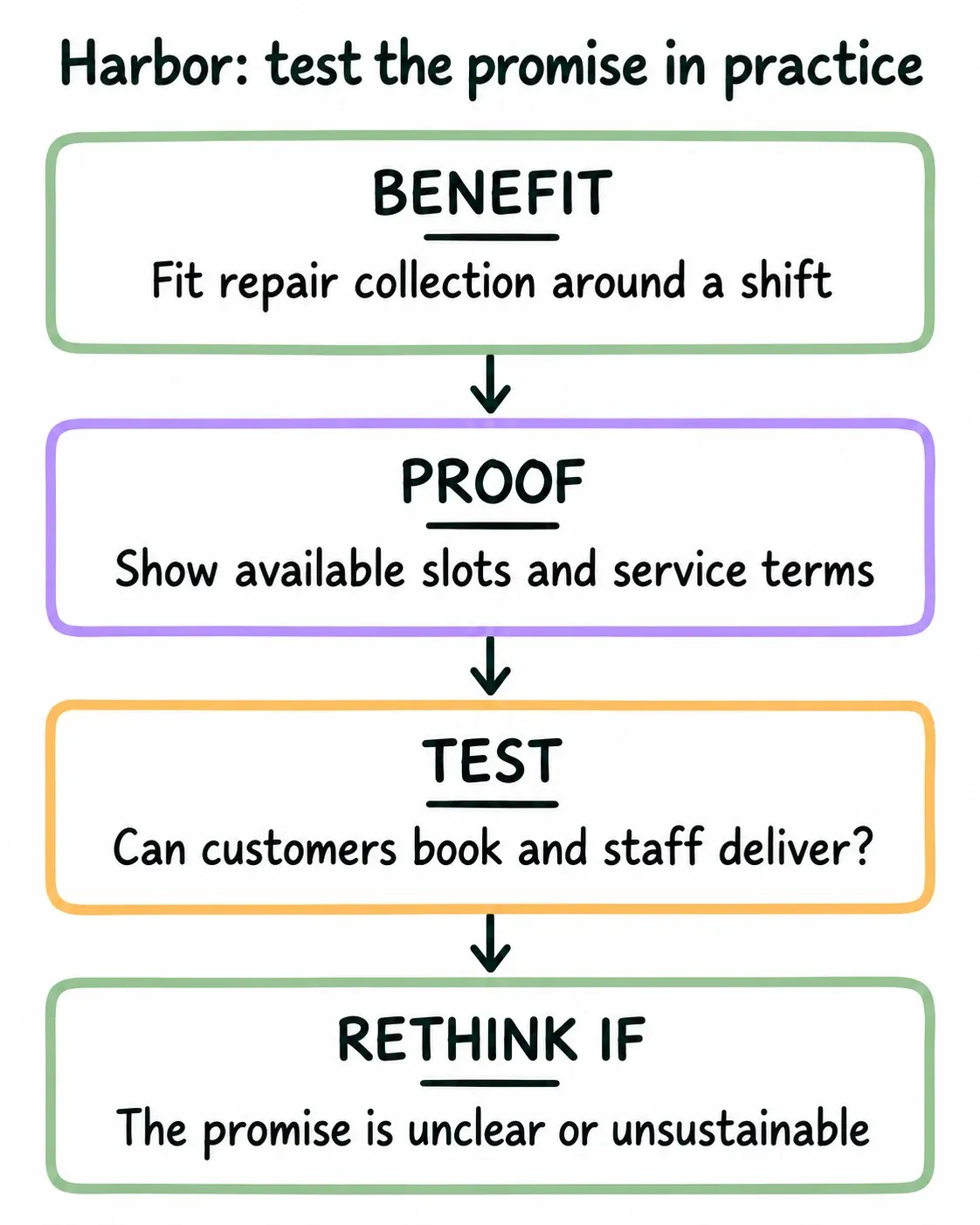
Finally, choose evidence at the right level. An available booking schedule can demonstrate collection options. It cannot demonstrate that every repair will finish the same day. A single customer’s account can illustrate an experience, but it does not support a universal time-saving claim.
The three-part benefit, difference, and proof approach is FrameworkWorld’s drafting aid. It helps test whether a proposition is defensible without pretending every successful offer must use the same sentence structure.
Draft Harbor’s promise with its conditions visible
The first draft says the shop offers excellent quality and friendly service. Those claims provide little reason for a commuter to choose it over another competent shop.
The team instead focuses on shift workers who cannot attend normal daytime appointments. Harbor Cycle can offer bookable early collection slots on selected weekdays, with the available slots visible before a booking is confirmed. The proposed benefit is fitting a repair handoff around a shift; the difference is the specific collection arrangement.
The team tests a message about early collection, supported by the actual booking schedule and a clear explanation of eligible locations. It does not promise same-day repair because collection timing does not guarantee parts availability or repair duration.
If interviews show that uncertainty about completion matters more than collection, the team must reconsider the proposition. A distinctive operating detail is only useful when it solves the audience’s actual concern.
Make the proposition specific enough to challenge
| Draft claim | What a customer still needs | More useful direction |
|---|---|---|
| Excellent service | What changes in my day? | A collection arrangement that fits the shift |
| Convenient repairs | When and where is it available? | Selected early slots with eligibility shown |
| Same-day peace of mind | Can that completion promise be supported? | State collection and completion conditions separately |
The last row is a rejected teaching draft, not a promise Harbor makes. Collection flexibility does not establish parts availability or repair duration. Keeping those claims separate protects the customer’s ability to choose.
Test the proposed sentence by asking suitable customers to explain it back. What do they think they can book? Which condition matters? What would they compare it with? These questions reveal misunderstanding more directly than asking whether the slogan sounds appealing.
Then investigate value. A perfectly understood promise may still address a secondary concern. If customers mainly worry about completion uncertainty, the team should examine whether it can provide useful estimates or updates. That is an offer-design question as well as a wording question.
Avoid responding to weak interest with stronger superlatives. “Best” or “fastest” increases the burden of proof without necessarily making the benefit more relevant. A narrower statement customers can verify often gives the next sales conversation a clearer starting point.
Review the proposition when operations or alternatives change. If early collection fills beyond capacity, the team must adjust availability or delivery resources before repeating the same promise in more places. If competitors match the service, ask what customers now value rather than keeping the word unique by habit.
Check understanding, value, and delivery separately
First ask suitable customers what they believe the sentence lets them book. Then investigate whether that benefit matters compared with alternatives. Finally, check whether staff can deliver the offered slots at a sustainable cost.
If completion uncertainty matters more than collection, Harbor should revisit the proposition and the service. If readers infer guaranteed same-day repair, the wording needs repair immediately. A USP succeeds by explaining a useful, supportable difference, not by outgrowing the evidence behind it.
Build and test the proposition
- Choose one audience and buying situation. Write down the alternative customers use today.
- Review interviews, sales objections, lost deals, and observable competitor offers. Separate customer evidence from internal preferences.
- List candidate benefits and the specific capabilities or delivery practices behind them.
- Remove claims that you cannot substantiate or reliably fulfill. Ask operations and customer support to challenge the remaining promises.
- Draft a sentence connecting audience, benefit, and difference. Keep the evidence close enough that a buyer can inspect it.
- Test whether prospective customers understand the sentence and why it matters. Ask them to explain it back rather than merely say whether they like it.
- Compare the message with actual buying behavior when feasible. Revise if readers understand the promise but do not value it.
A working sentence is: “For [audience facing a situation], our offer provides [benefit] through [specific difference], supported by [evidence].” It is a planning aid. The published wording can be shorter and more natural.
Common mistakes and limitations
A USP is not necessarily a slogan. A memorable line may express personality while leaving the reason to choose unclear. Start with the underlying proposition, then decide how the words should appear in each channel.
Avoid unsupported superlatives such as fastest, best, or only. Narrow the claim to what you can demonstrate. Similarly, do not make a service commitment that depends on capacity the team has not reserved.
A USP can also become stale. Competitors can match a capability and customer priorities can change. Review the proposition when the offer, alternatives, or repeated buying objections change.
Use a broader positioning exercise when the disagreement concerns the market category, audience, or competitive frame. A sentence alone cannot resolve those strategic choices.
Related frameworks
Marketing Mix checks product, price, place, and promotion together. Use it to make sure the promise agrees with what the customer receives, pays, and can access.
AIDA structures a message through attention, interest, desire, and action. Use it to present a defensible proposition after deciding what the offer should promise.
Sources and further reading
- Business Development Bank of Canada, How to find your unique selling point, accessed October 21, 2026. Institutional guidance on customer-relevant differentiation. The three-part drafting aid, test process, and fictional repair service are FrameworkWorld’s applications.