A better advert cannot deliver an impossible offer
Plain Desk’s advert promises a desk delivered ready to use, anywhere in the country. Operations has booked a parcel carrier. The introductory price assumes a simple one-person delivery. None of those plans looks absurd on its own. Put them together and somebody is going to be holding an Allen key they did not expect.
Plain Desk is a hypothetical furniture company offering desks to people working from home. Its launch plans, service boundaries, and proposed tests below are fictional.
The marketing mix organizes four connected decisions: product, price, place, and promotion. The American Marketing Association describes these four Ps as a way to examine marketing strategy. Product is the offer, price is the payment, place concerns access and distribution, and promotion communicates it.
Follow one customer promise across the four decisions
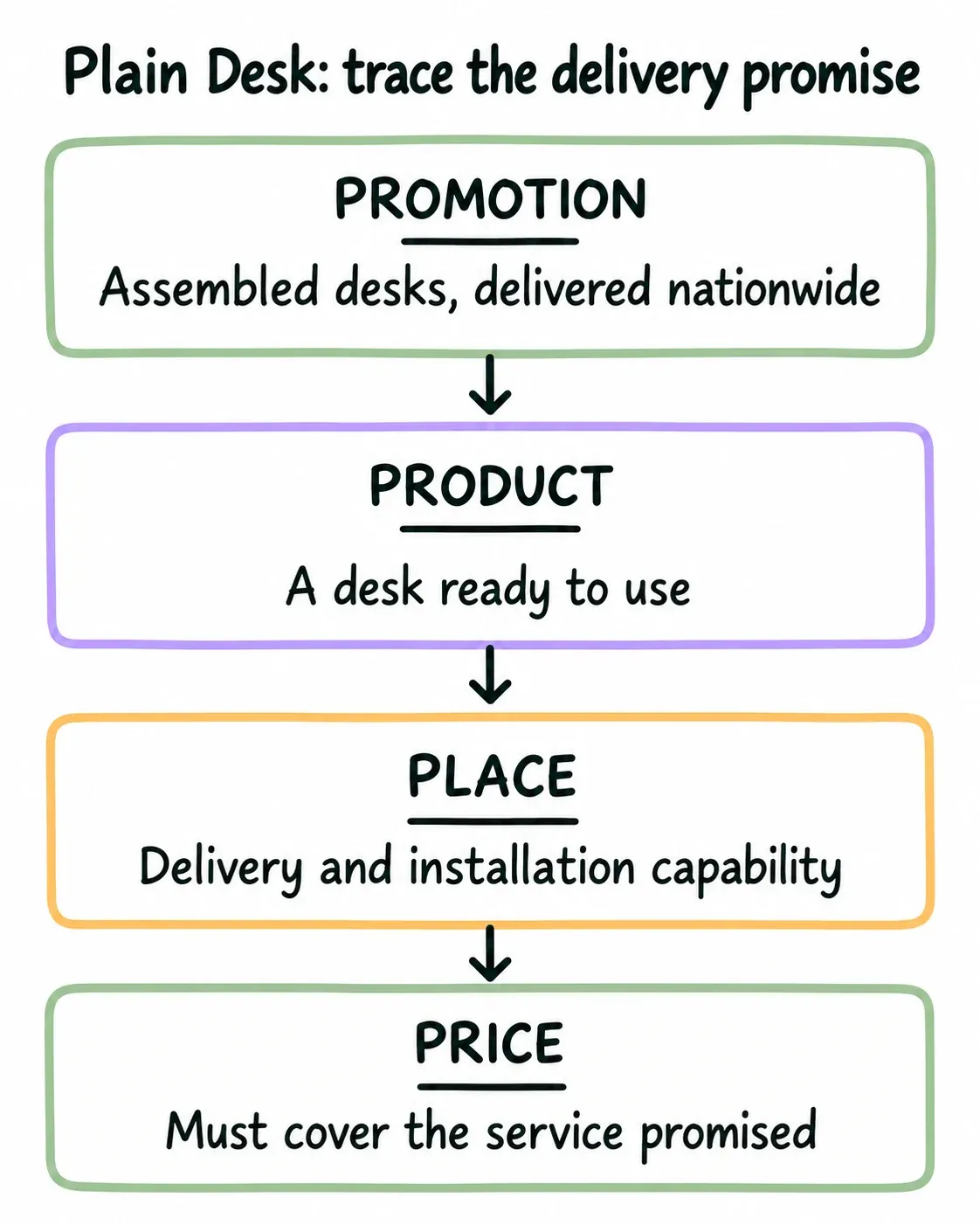
For this offer, assembly is part of the product experience. It needs an installation-capable delivery arrangement and a price that covers the work. Promotion must describe the service customers can actually receive.
The first map traces the contradiction before the team spends on a campaign. The question is not which P “owns” delivery. The question is whether the same promise survives from the advert through payment to the customer’s room.
Make four decisions that fit together
One customer group
Product
What useful offer does the customer receive?
Price
What do they pay, and on what terms?
Place
How do they buy and receive the offer?
Promotion
How will they understand the offer and respond?
The customer sits at the center because all four decisions must make sense to the same audience. Read around the four parts rather than treating them as a sequence. A change to one part can require changes to the others.
Product: what is the customer buying?
Specify the offer and the problem it addresses. Include the service around it: installation, support, returns, or delivery commitments can change what someone believes they are buying.
FrameworkWorld recommends finishing this block with a sentence a customer could challenge. “A desk delivered assembled within the city” is clearer than “premium convenience.” The first sentence exposes operational commitments; the second hides them.
Price: what does the commitment cost?
State the amount, payment basis, and important conditions. A low monthly headline can conceal a long contract. An expensive product can be credible if buyers understand what the cost covers.
Check the price against the offer and its delivery cost. Do not select a discount simply because the promotion budget needs a response. Ask what happens to the ability to serve customers if the offer sells at that price.
Place: how does the offer reach the buyer?
Place includes the route to purchase and delivery. A retailer, marketplace, direct website, and sales representative create different experiences and obligations.
Write down the actual buying path. If the target customer needs an approved supplier but the plan offers only a card checkout, the distribution choice is incomplete. More advertising cannot remove that purchasing barrier.
Promotion: what will people learn and do?
Choose communication that explains the offer where the intended audience can encounter it. A credible demonstration may help more than repeating a broad claim.
Decide what the first message must establish and what action it should support. Keep every promise consistent with product, price, and availability. Promotion should describe a deliverable offer.
Look for the promise that changes another P
A delivery promise belongs in more than the promotion box. It changes what the customer is buying, which channel can provide it, and what the price must cover. Trace those effects before approving the copy.
For Plain Desk, in-room assembly makes transport and installation part of the product experience. A nationwide parcel network may deliver a flat-packed desk efficiently without being able to deliver that different promise. The channel can be good at its job and still be wrong for this offer.
Price also communicates expectations. A low introductory amount can attract buyers, but it may be unsustainable if it excludes a necessary installation cost. State what the amount includes and which conditions apply before testing demand.
Start with a realistic buying path. Can someone check service availability before paying? Can they choose a suitable slot? What happens if access to the room is difficult? The four Ps do not require every operational detail on a marketing page, but the team should know which commitments the offer creates.
Then review the promotion against that path. If the promise depends on an exception, qualification, or separate charge, it should not disappear between the advert and checkout. Coherence is something you can inspect before you know whether the campaign will sell.
Revise Plain Desk’s offer across the four Ps
Its initial promotion promises convenient delivery everywhere. The product plan includes in-room assembly, but the place decision relies on a parcel carrier. Its introductory price also assumes that a single person can complete each delivery. The mix exposes the contradiction before the campaign goes live.
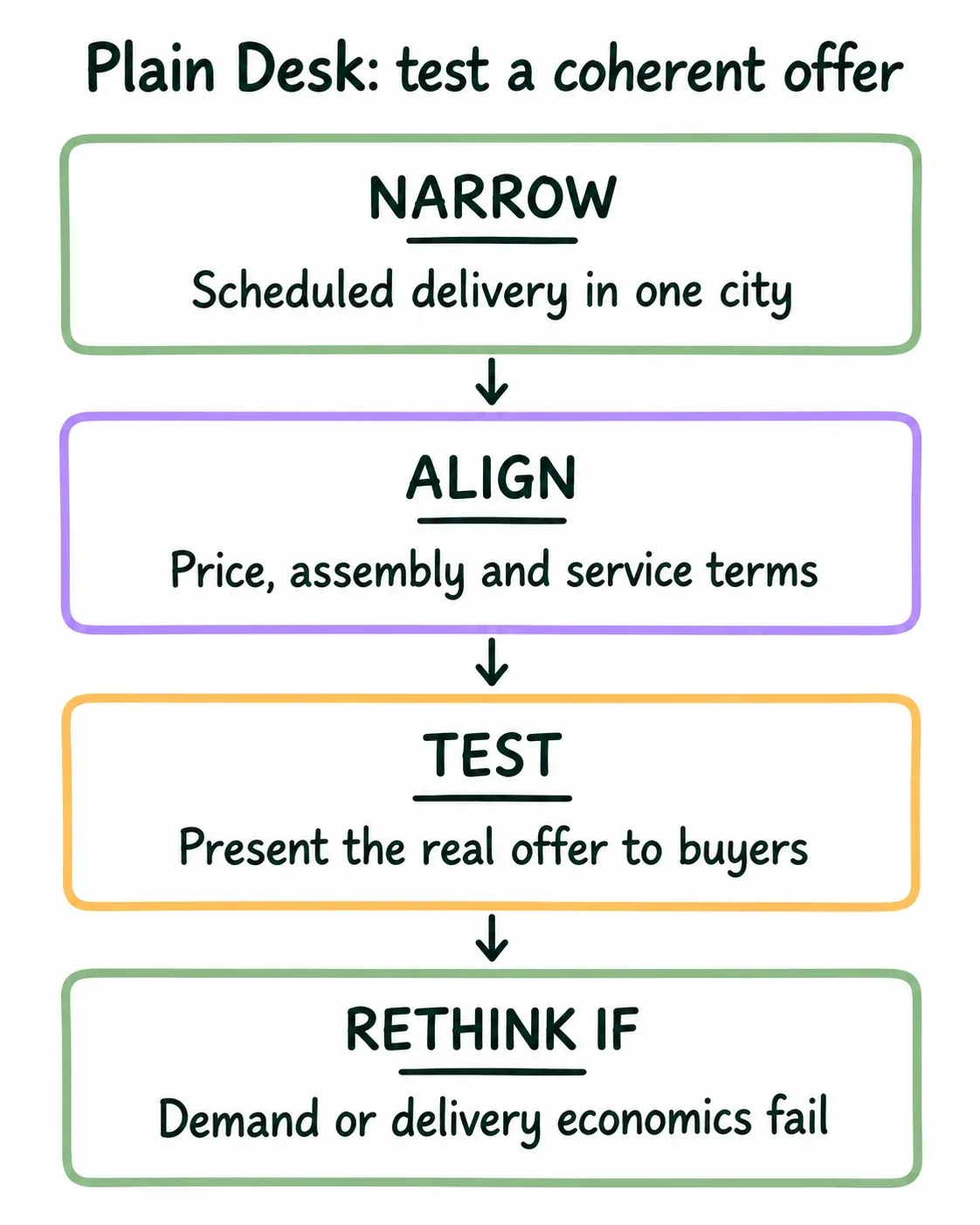
The team changes the initial offer to assembled delivery within one city using scheduled installation slots. It sets a price that includes that service and describes the service boundary prominently. Promotion now shows the delivery experience rather than implying nationwide availability.
The first test asks whether buyers in the service area will book a delivery slot at the stated price. A poor response could indicate a problem with price, product, audience, or communication. The team will need follow-up evidence to distinguish them; the four Ps do not diagnose the cause automatically.
Compare the launch before and after the review
| P | Initial contradiction | Revised hypothetical pilot |
|---|---|---|
| Product | Assembled delivery promised | Desk with scheduled installation |
| Price | Assumes a simple one-person delivery | Includes the stated installation service |
| Place | Parcel carrier, nationwide | Scheduled slots within one city |
| Promotion | Convenient delivery everywhere | Clear local service boundary |
The narrower pilot is not automatically the better business. It is a more coherent offer to test. Plain Desk can now ask whether customers in the actual service area value the service at the stated price.
Choose one uncertainty to investigate first. If customers cannot tell whether their address qualifies, fix that comprehension gap before treating abandoned bookings as a verdict on price. If they understand the offer but do not value assembly, investigate the product promise.
Avoid changing all four Ps at once unless the whole model requires it. A new price, audience, service area, and advert can produce a result without revealing which change mattered. Keep a record of the offer tested and what you learned from customer behavior and follow-up conversations.
Also check delivery after the sale. A campaign can create bookings while missed installation slots damage the experience. Demand and the ability to fulfill it need to be reviewed together.
The review has earned its place when it changes an assumption or resolves a contradiction. Four completed boxes are not evidence of customer demand; they are a clearer description of what you are asking customers to choose.
Test the offer customers can actually receive
Plain Desk narrows the initial service to scheduled installation within one city and prices that service explicitly. Now it can test a real offer: a qualifying address, a stated amount, an available slot, and a desk delivered as described.
Weak demand still needs interpretation. Did customers understand the boundary? Did they value assembly? Was the price acceptable? Check fulfillment as well as bookings. The four Ps make the offer coherent enough to investigate; they do not reveal the winning combination automatically.
How to check a launch with the marketing mix
The following review is FrameworkWorld’s suggested application of the four decisions.
- Define one audience and buying occasion. “Small businesses” is too broad if some buy through procurement and others buy immediately.
- Write the product promise in concrete terms. Ask operations what must happen to keep it.
- Specify the price and conditions. Check whether the delivery plan can support them.
- Walk through discovery, purchase, receipt, and support. Remove contradictions between the chosen channel and the audience’s habits.
- Draft the promotion last. Check each claim against the other three blocks.
- Choose one unresolved assumption to test before a wider launch. Agree what observation would make you change the mix.
A useful review ends with a decision, such as changing the service area or packaging. Four lists with no connection will not improve a launch.
When to use it and what to watch
Use the mix to prepare a launch, review a weak offer, or align marketing with sales and operations. It works best after you have some evidence of what customers need.
Do not treat each P as a separate department’s slide. An unavailable product with a compelling campaign is still unavailable. Equally, copying a competitor’s price without its costs or channel economics can create a fragile offer.
The model is a checklist, not a prediction of demand. It does not supply a research method, a positioning decision, or a financial forecast. For services, the extended 7 Ps can also examine people, process, and physical evidence; those additions are useful when delivery experience needs more attention than the four-part view gives it.
Alternatives and related frameworks
AIDA checks whether one message earns attention, interest, desire, and action. Use it inside the promotion decision once the offer is coherent.
Sales Funnel helps measure where prospects progress or leave. A weak conversion stage is a reason to investigate the mix, not proof that promotion is the problem.
Business Model Canvas adds partners, activities, resources, relationships, and revenue logic. Use it when the decision reaches beyond the market-facing offer into how the business operates.
Sources and further reading
- American Marketing Association, The Four Ps of Marketing, 2022. Professional association explanation of the four decisions. The review steps and fictional example above are FrameworkWorld’s application.